


Training a new puppy can be exciting, but it can also be challenging.
Puppies are still learning how the world works. They may chew things, have accidents, become distracted, jump up, or struggle to understand what you want.
Some training difficulties are completely normal.
However, certain common mistakes can make the process harder for both you and your puppy.
Understanding these puppy training mistakes can help you build a more consistent and positive training routine.
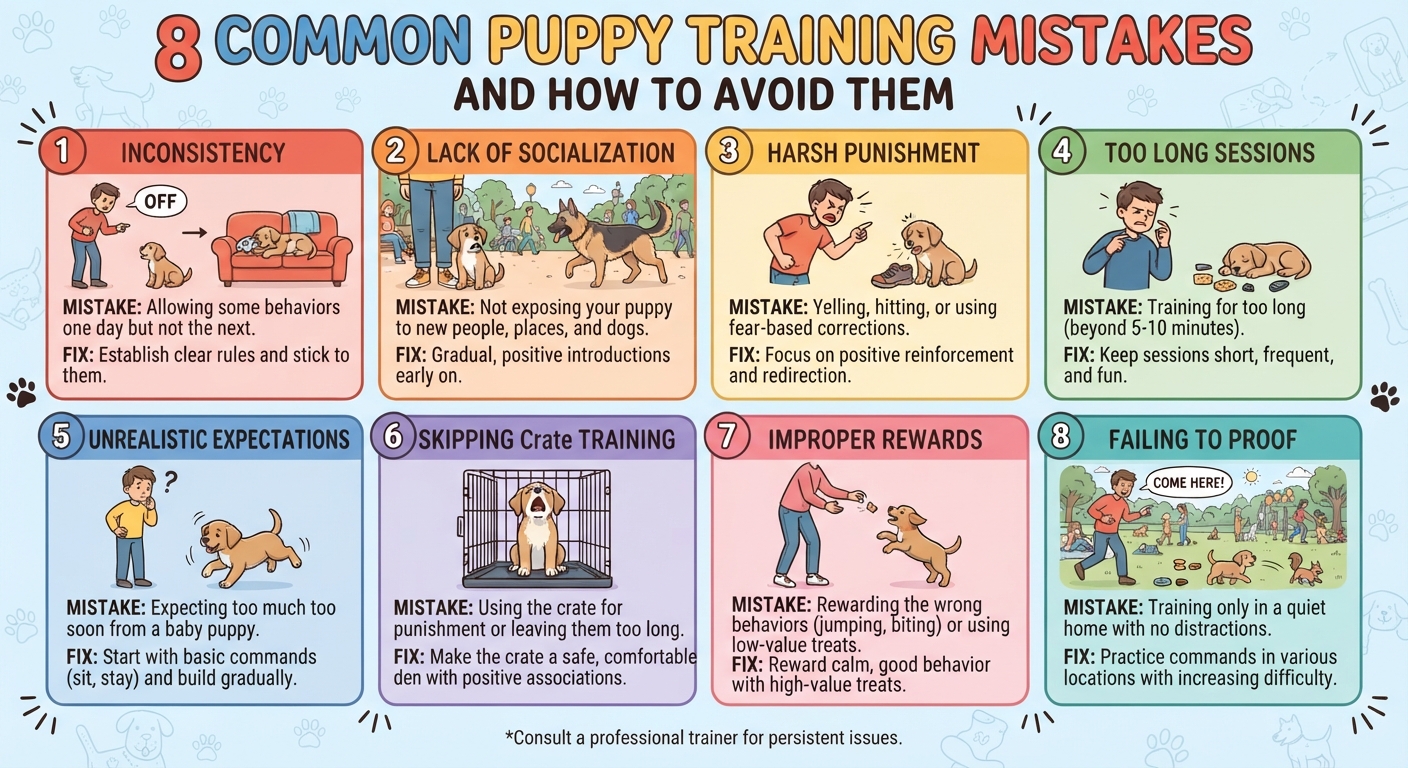
1. Expecting Too Much Too Soon
One of the biggest mistakes new owners make is expecting a puppy to behave like a trained adult dog.
Puppies have limited attention spans and are still developing physically and mentally.
Training should therefore happen in small steps.
Instead of expecting your puppy to understand a complicated command immediately, break the behavior into simple stages.
Celebrate small improvements.
2. Using Inconsistent Commands
Imagine one person says “down,” another says “off,” and someone else uses a completely different phrase for the same behavior.
A puppy can easily become confused.
Everyone in the household should try to use the same basic commands.
Consistency helps your puppy understand what behavior is expected.
Choose simple words and use them consistently.
3. Training for Too Long
Long training sessions can quickly become frustrating for a young puppy.
Short sessions are often easier for puppies to handle.
You might practice for a few minutes at a time several times throughout the day.
Training can also happen naturally during everyday activities.
For example, ask your puppy to sit before putting down their food or before opening a door.
4. Punishing Mistakes
Punishment can create fear and confusion rather than teaching your puppy what to do instead.
If your puppy makes a mistake, focus on preventing the behavior from happening again and teaching a more appropriate alternative.
For example, if your puppy keeps chewing furniture, provide an appropriate chew toy and manage access to the furniture.
Training should focus on teaching the desired behavior.
5. Forgetting to Reward Good Behavior
Puppies need to understand what behavior earns rewards.
When your puppy does something correctly, reinforce it promptly.
Rewards can include:
- Small treats
- Praise
- Toys
- Play
- Attention
The appropriate reward depends on what motivates your puppy.
6. Ignoring the Importance of Routine
Puppies benefit from predictable routines.
Regular times for meals, toilet breaks, sleep, play, and training can make daily life easier.
A routine can also help you anticipate when your puppy is likely to need a bathroom break.
While your schedule doesn’t need to be identical every day, consistency can help your puppy understand what to expect.
7. Allowing Unwanted Behaviors Sometimes
Inconsistent rules can make training confusing.
If jumping on people is forbidden but your puppy is allowed to jump on certain visitors, they may struggle to understand when the behavior is acceptable.
Household members should agree on basic rules.
If you don’t want your adult dog to sleep on the sofa, for example, consider whether allowing the puppy to do so regularly is likely to create confusion later.
8. Forgetting Mental Stimulation
Training isn’t only about obedience.
Puppies need opportunities to explore, sniff, play, and learn.
Age-appropriate puzzle toys, supervised exploration, basic training games, and safe social experiences can all contribute to development.
A puppy that receives appropriate mental stimulation may have more opportunities to learn desirable behaviors.
How to Make Puppy Training Easier
Start with a few basic goals.
You might focus on:
- Learning their name
- Responding to simple cues
- Appropriate chewing
- Toilet training
- Handling and grooming
- Calm behavior
- Safe social experiences
Don’t try to teach everything at once.
Use Positive Reinforcement
Positive reinforcement means rewarding behavior you want to encourage.
For example, if your puppy sits calmly instead of jumping on you, reward the calm behavior.
Over time, the puppy learns that calm behavior produces desirable consequences.
The reward doesn’t always have to be food.
Some puppies respond strongly to toys, play, praise, or attention.
Make Training Part of Everyday Life
You don’t need a formal training session every time you teach your puppy something.
Use everyday opportunities.
Before opening the door, ask for a simple behavior.
Before feeding, practice waiting briefly.
During play, practice exchanging a toy.
These small moments can add up to significant learning over time.
Frequently Asked Questions
What is the biggest puppy training mistake?
Expecting a puppy to learn everything quickly is a common problem. Puppies need repetition, patience, and age-appropriate expectations.
Should I punish my puppy for bad behavior?
Instead of punishment, focus on managing the environment and teaching your puppy an appropriate alternative behavior.
How long should puppy training sessions be?
Keep sessions short and age-appropriate. Several brief sessions can work better than one long session.
When should I start training my puppy?
Training can begin as soon as your puppy comes home, with exercises appropriate for their age, development, health, and environment.
Final Thoughts
Training a puppy takes patience.
Avoiding common puppy training mistakes can make the learning process more enjoyable and productive for both you and your pet.
Keep commands consistent, reward desirable behavior, create predictable routines, and remember that puppies are still learning.
Progress may not always be perfectly consistent, but with regular practice and realistic expectations, your puppy can gradually develop the skills needed for everyday life.







Leave a comment