




Bringing home a new puppy comes with plenty of questions.
One of the most common is: When can puppies go outside?
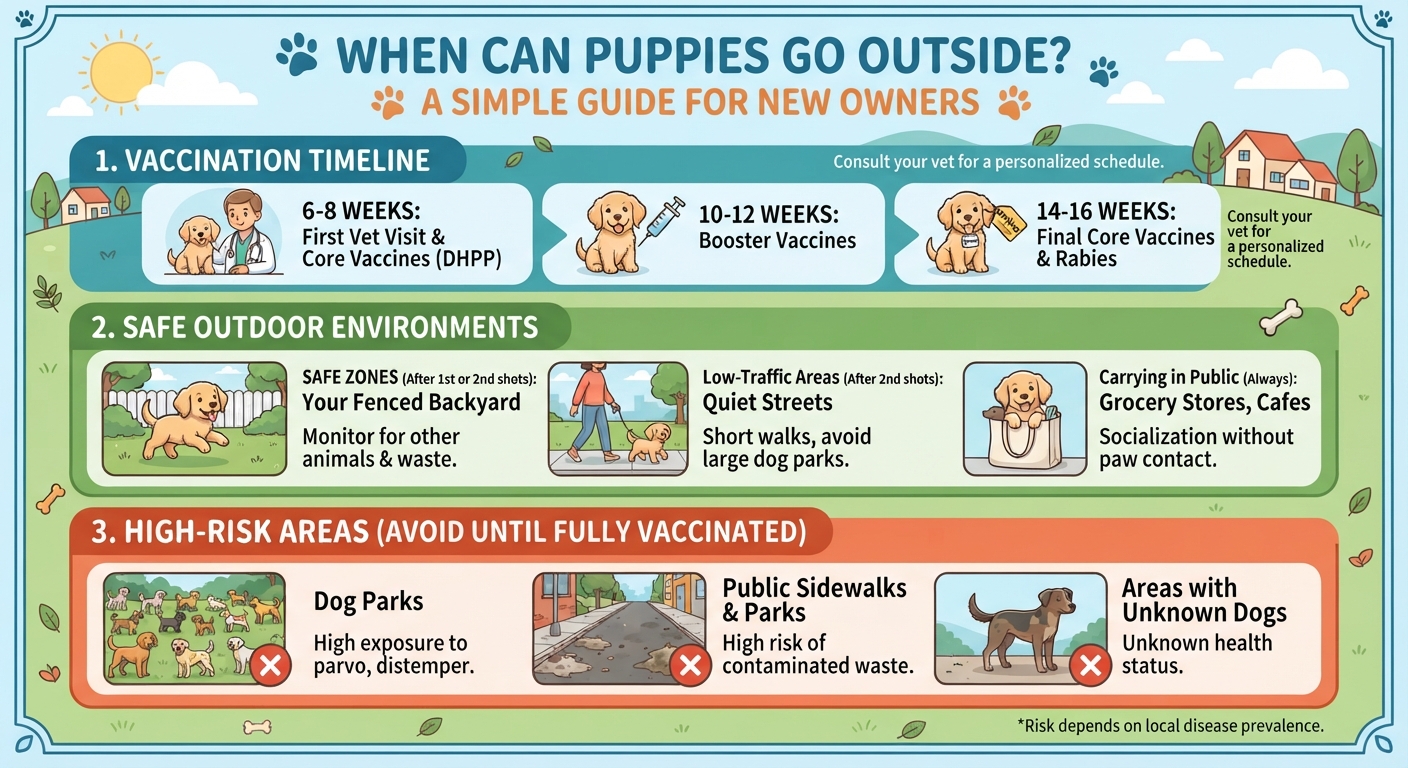
Going outdoors provides puppies with opportunities to explore, learn, exercise, and experience new environments. However, young puppies can be vulnerable to infectious diseases before they have completed their recommended vaccinations.
The right time for outdoor activities depends on the type of environment, your puppy’s vaccination status, local disease risks, and your veterinarian’s advice.
Why Can’t Puppies Immediately Explore Everywhere?
Young puppies may not yet have full protection against certain infectious diseases.
Public areas can expose puppies to contaminated soil, surfaces, feces, and other animals.
This doesn’t necessarily mean a puppy needs to stay isolated indoors until all vaccinations are completed.
Instead, owners should distinguish between safe exposure and high-risk environments.
Your veterinarian can advise you about the risks in your local area.
When Can Puppies Go Outside for the First Time?
There isn’t one universal age that applies to every puppy.
Vaccination schedules can vary depending on factors such as the puppy’s age, previous vaccinations, health, and local disease risks.
Your veterinarian should confirm when your puppy is adequately protected for normal public walks.
Until then, you can ask about safer ways to provide outdoor exposure.
Can Puppies Go Into the Garden?
A private garden may be a safer option than a public dog park, particularly if it is secure and the disease risk is low.
However, safety depends on the environment.
If unvaccinated or unknown dogs have recently used the area, contamination may still be possible.
Ask your veterinarian whether your garden is appropriate for your puppy.
How Can Puppies Experience the Outside Safely?
Puppies can benefit from carefully controlled exposure to the outside world.
Depending on your veterinarian’s advice, you may be able to:
- Carry your puppy outside
- Sit with them in a secure private garden
- Let them experience household sounds near an open window
- Take them in a clean carrier
- Introduce them to safe surfaces
- Let them observe traffic from a safe distance
- Introduce them to healthy, vaccinated dogs you know
The goal is to provide positive experiences without unnecessarily exposing the puppy to infectious risks.
Socialization Is Important
The early puppy period is an important time for learning about the world.
Socialization isn’t simply about meeting as many dogs as possible.
It can include experiencing:
- Different people
- Household noises
- Car journeys
- Different surfaces
- Gentle handling
- New environments
- Everyday sounds
These experiences should be gradual and positive.
Don’t overwhelm your puppy by introducing too many new things at once.
What About Puppy Classes?
Puppy classes can provide valuable training and controlled socialization.
However, the health requirements vary between classes.
Before enrolling, ask about:
- Vaccination requirements
- Cleaning procedures
- Class size
- Puppy age requirements
- Whether sick dogs are excluded
Your veterinarian can also help you decide when a class is appropriate.
When Can Puppies Go on Walks?
Your veterinarian can tell you when your puppy has sufficient protection for public walks.
When you receive the go-ahead, start gradually.
Your puppy may initially find everything exciting or overwhelming.
Keep early walks short and focus on allowing your puppy to explore calmly.
Don’t expect a young puppy to immediately walk perfectly on a leash.
Why Shouldn’t You Rush the First Walk?
A first walk can involve many new experiences at once:
- Cars
- Bikes
- People
- Dogs
- Traffic noise
- New smells
- Different surfaces
A puppy may need time to process everything.
Let your puppy investigate at a comfortable pace.
If they appear frightened or overwhelmed, increase distance from the trigger and give them time to settle.
What Should You Do If Your Puppy Picks Something Up?
Puppies naturally explore with their mouths.
Outdoor areas may contain objects that are unsafe to eat.
Teaching a simple “leave it” cue can be useful.
Don’t panic if your puppy picks up something. Calmly redirect them and remove the object when safe.
If your puppy swallows something potentially dangerous, contact your veterinarian promptly.
Can Puppies Meet Other Dogs?
Puppies benefit from appropriate social contact, but interactions should be carefully managed.
Choose healthy, vaccinated dogs with appropriate temperaments.
Avoid forcing interactions.
A puppy should be able to move away if they become uncomfortable.
Positive experiences are more valuable than simply maximizing the number of dogs they meet.
Frequently Asked Questions
When can puppies go outside after vaccinations?
The timing depends on the puppy’s vaccination schedule and local disease risks. Your veterinarian should confirm when normal public outings are appropriate.
Can an unvaccinated puppy go into the garden?
It may be possible in a controlled, low-risk private environment, but this depends on the garden and local disease risks. Ask your veterinarian.
Can I carry my puppy outside before vaccinations are complete?
Carrying a puppy can provide controlled exposure to outdoor sights and sounds without allowing them to walk on potentially contaminated surfaces. Discuss the safest approach with your veterinarian.
Can puppies meet vaccinated dogs?
Controlled interaction with healthy, vaccinated dogs may be appropriate, depending on your veterinarian’s advice and the puppy’s vaccination status.
Final Thoughts
Knowing when puppies can go outside isn’t simply about reaching a particular age.
Vaccination status, local disease risks, environment, and your puppy’s health all matter.
At the same time, puppies shouldn’t necessarily miss out on learning about the world.
Ask your veterinarian about safe forms of early outdoor exposure, then gradually introduce your puppy to new experiences in a calm and positive way.






Leave a comment