



You don’t need a professional training facility to teach your dog useful skills. Your home can become a great learning environment with a few treats, some patience, and a consistent approach.
Whether you’re raising a young puppy or teaching an adult dog new skills, training can be more enjoyable when you turn it into a game instead of treating every session like a strict lesson.
From teaching basic commands to creating simple training games with everyday household items, here’s how to train your dog at home while strengthening the bond between you and your furry companion.
1. Start With Fun Training Games
Training doesn’t have to mean sitting in one place and repeating the same command over and over.
Games can make learning more interesting while giving your dog opportunities to practice useful behaviors.
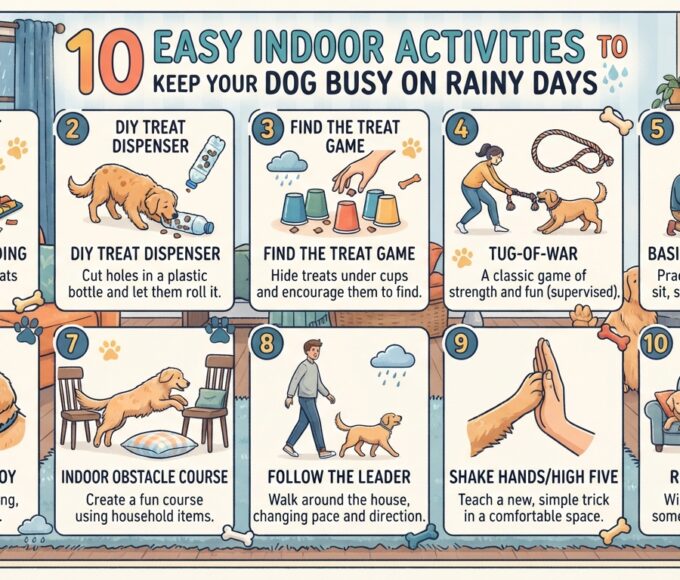
Try a Simple Home Obstacle Course
You can create a beginner-friendly course using safe household objects.
For example:
- Walk around cushions
- Go through a large open cardboard box
- Step over a low, stable obstacle
- Follow you between chairs
- Move from one designated spot to another
Keep obstacles low and stable, and avoid anything that could collapse, slip, or cause your dog to jump from a dangerous height.
You can incorporate commands such as “wait,” “come,” “sit,” or “touch” while moving through the course.
Play Hide-and-Seek
Ask your dog to stay, move to another room or hiding spot, and then call them.
When your dog finds you, reward them with praise, a treat, or a favorite toy.
This can make coming when called more engaging while also giving your dog an opportunity to use their senses.
Try a Simple Find-It Game
Hide a few treats around an easy-to-search area and encourage your dog to find them.
Start with obvious hiding places and gradually make the game more challenging as your dog understands what to do.
Training Games at a Glance
| Game | What It Can Practice |
|---|---|
| Obstacle course | Focus, following cues, body awareness |
| Hide-and-seek | Recall and searching |
| Find-it game | Nose work and problem-solving |
| Tug with rules | Impulse control and engagement |
The goal isn’t to make your dog perfect. The goal is to make learning rewarding enough that your dog wants to participate.
2. Teach Essential Commands First
Before moving on to complicated tricks, focus on useful everyday behaviors.
Good beginner commands include:
Sit
“Sit” can become a foundation for teaching patience and calm behavior.
Reward your dog as soon as they perform the desired behavior.
Down
Teaching your dog to lie down can be useful for encouraging calm behavior at home.
Stay
“Stay” teaches your dog to remain in position until you give them another cue.
Start with very short durations and gradually increase the difficulty.
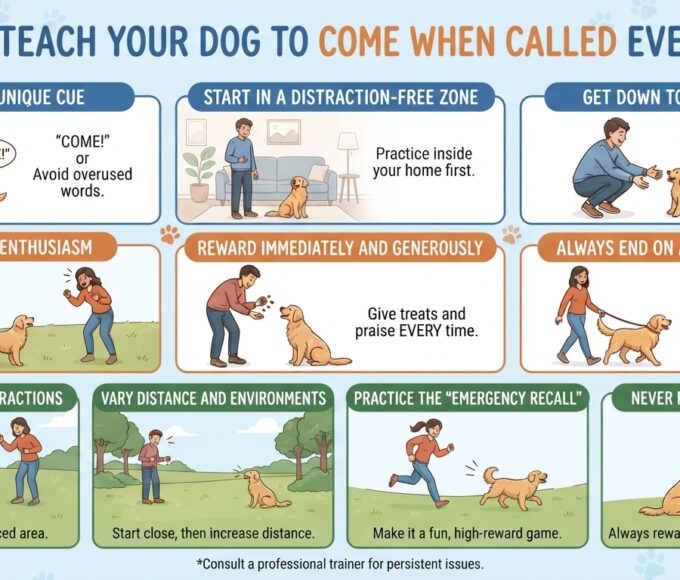
Come
A reliable recall can be extremely useful for safety.
Practice in a controlled environment first and gradually introduce distractions as your dog becomes more reliable.
Leave It
This teaches your dog to disengage from something you don’t want them to touch.
It can be especially useful around food, household objects, or things they find outdoors.
Don’t Expect Every Command to Take the Same Amount of Time
Dogs learn at different speeds. Age, temperament, previous experience, motivation, distractions, and the complexity of the behavior can all affect training.
Instead of expecting a command to be mastered within a specific number of days, look for gradual improvement.
3. Use Positive Reinforcement
One of the most useful principles for home training is rewarding the behavior you want to see again.
Depending on what motivates your dog, rewards can include:
- Small food treats
- Praise
- Petting
- A favorite toy
- A short play session
- Access to something the dog enjoys
For example, if you’re teaching “sit,” reward your dog immediately after they sit.
Over repeated practice, your dog can learn that responding to the cue leads to something worthwhile.
Keep Rewards Meaningful
You don’t always have to use food.
Some dogs are highly motivated by toys or play, while others prefer praise or access to something interesting.
Pay attention to what your individual dog finds rewarding.
4. Keep Training Sessions Short
Long training sessions can become frustrating for both you and your dog.
Instead, use short sessions throughout the day.
You might practice for a few minutes:
- Before a meal
- During a play session
- After a walk
- While waiting for food
- Before going outside
- During quiet time at home
If your dog becomes distracted or stops responding, don’t automatically assume they’re being stubborn.
They may be tired, confused, overstimulated, or simply ready for a break.
End on an easy success and try again later.
5. Turn Everyday Moments Into Training Opportunities
Formal training sessions aren’t the only time your dog can learn.
You can incorporate training into normal household routines.
For example:
Before opening the door: Ask your dog to wait.
Before putting down dinner: Ask for a simple behavior such as sitting.
Before throwing a toy: Ask your dog to wait briefly.
Before crossing a doorway: Practice walking calmly beside you.
When greeting visitors: Reward calm behavior instead of jumping.
These small repetitions can help turn desirable behaviors into everyday habits.
6. Use Household Items Carefully
You don’t need expensive equipment for every training exercise.
Some everyday objects can be useful when they’re clean, stable, and safe.
Cardboard Boxes
A large, open cardboard box can become a simple exploration activity.
You can encourage your dog to walk around it, approach it, or investigate it.
Towels
A towel can be incorporated into certain supervised scent or food-enrichment games.
Don’t use old clothing or fabric for tug games if your dog tends to shred and swallow pieces.
Plastic Containers
A sturdy, dog-safe container can sometimes be used for simple food puzzles, but avoid bottles or objects that can break, create sharp edges, or become choking hazards.
Household Training Ideas
| Item | Possible Use |
|---|---|
| Cardboard box | Exploration or simple obstacle |
| Towel | Supervised enrichment |
| Plastic container | Food puzzle if appropriately designed |
| Cushions | Walking around or targeting exercises |
| Paper cups | Simple supervised scent game |
Safety comes first. Avoid household objects that can splinter, break apart, become lodged in your dog’s throat, or contain materials they could swallow.
7. Make Distractions Part of Training Gradually
A dog that responds perfectly in your quiet living room may struggle when a squirrel runs past outside.
That’s normal.
Dogs need to learn behaviors in different environments.
Start with an easy location and gradually increase distractions.
For example:
Step 1: Practice “come” inside the house.
Step 2: Practice in another room.
Step 3: Practice in a quiet enclosed outdoor area.
Step 4: Gradually introduce mild distractions.
Step 5: Continue practicing in increasingly challenging environments.
Don’t make the environment so difficult that your dog repeatedly fails.
If your dog can’t respond, make the exercise easier and try again.
8. Practice Impulse Control
Impulse control helps dogs learn to pause instead of immediately reacting to something exciting.
You can practice simple exercises around the home.
For example, hold a treat in your closed hand.
Your dog may sniff or paw at your hand. Wait calmly.
When your dog stops trying to get the treat and gives you a moment of calm attention, reward them.
You can gradually build similar skills around:
- Toys
- Food
- Doors
- Visitors
- Walks
- Exciting sounds
Keep the exercises easy enough that your dog can succeed.
9. Make Training Rewards Part of the Daily Routine
Treats can be useful, but don’t let training become nothing more than feeding your dog constantly.
Use appropriately sized rewards and account for treats as part of your dog’s overall daily food intake.
You can also use play, praise, or access to favorite activities as rewards.
For example:
Sit → praise → toy
Come → treat → play
Wait → release cue → access to the yard
This teaches your dog that responding to you can lead to different positive outcomes.
10. Stay Consistent With Your Commands
Imagine one person says “down” while another says “off” for the same behavior.
Your dog may have difficulty understanding what everyone expects.
Choose clear cues and encourage everyone in the household to use them consistently.
Also avoid repeatedly saying a command when your dog isn’t responding.
Instead, make the situation easier, regain their attention, and try again.
Consistency isn’t about being strict. It’s about making the rules easier for your dog to understand.
11. Reward Small Improvements
Training progress isn’t always dramatic.
Maybe your dog used to jump on visitors ten times and now does it only twice.
Maybe they used to ignore “come” completely but now turn toward you.
Those small improvements matter.
Rather than waiting for perfect behavior before rewarding your dog, reinforce useful steps along the way.
Examples of Training Milestones
| Progress | Possible Reward |
|---|---|
| Responds to their name | Praise or treat |
| Sits on cue | Treat or play |
| Waits briefly | Praise and release |
| Comes when called indoors | Favorite reward |
| Walks calmly past a distraction | Praise or treat |
Your dog doesn’t need to perform perfectly every time for training to be working.
12. Don’t Punish Mistakes
Dogs make mistakes while learning.
If your dog doesn’t understand a behavior, punishment usually doesn’t explain what you actually want them to do instead.
A better approach is to:
- Stay calm.
- Interrupt unsafe or unwanted behavior when necessary.
- Redirect your dog toward an appropriate behavior.
- Reward the behavior you want.
- Adjust the training environment if your dog keeps struggling.
For serious behavior problems such as aggression, severe fear, or dangerous reactivity, consider working with a qualified veterinary behavior professional or experienced reward-based trainer.
13. Keep Training Enjoyable
Your attitude can influence the training session.
If you’re frustrated, take a break.
If your dog is becoming overwhelmed, simplify the exercise.
You can finish with something your dog already knows, give them a reward, and stop for the day.
A successful session doesn’t need to teach five new commands.
Sometimes practicing one familiar behavior successfully is enough.
Frequently Asked Questions About Training Your Dog at Home
Can I really train my dog at home?
Yes. Many foundational behaviors can be practiced successfully at home. A quiet environment can actually make it easier to begin because there are fewer distractions.
As your dog’s skills improve, gradually practice in different locations and around appropriate distractions.
What should I teach my dog first?
Start with practical behaviors such as responding to their name, sitting, coming when called, waiting briefly, and leaving objects alone when asked.
Choose behaviors that are useful in your everyday life.
How long should a dog training session last?
There is no single perfect duration for every dog. Short, focused sessions are often easier to manage than lengthy lessons. If your dog loses focus or becomes frustrated, take a break and try again later.
How many times a day should I train my dog?
You can incorporate several short training opportunities into your day instead of relying on one long session.
Even a few minutes of practice during normal routines can add up.
Can toys be used as training rewards?
Absolutely. If your dog loves a particular toy or game, it can be an effective reward for appropriate behavior.
What if my dog doesn’t understand a command?
Make the exercise easier.
Break the behavior into smaller steps, use a more valuable reward, reduce distractions, or take a short break.
Avoid simply repeating the same command louder and louder.
My dog gets distracted easily. What should I do?
Start training somewhere with fewer distractions.
Once your dog understands the behavior, gradually introduce more challenging environments.
Remember that distraction itself is a skill to work on.
Should I use treats for every successful behavior?
Treats can be very useful during training, especially while teaching a new behavior. As your dog becomes more reliable, you can vary the rewards and use praise, toys, play, or other appropriate rewards as well.
What should I do about unwanted behavior?
First consider why the behavior is happening. Then manage the environment, redirect your dog toward an appropriate behavior, and reward that behavior.
For persistent or potentially dangerous problems, seek professional guidance.
A Simple Home Training Routine
If you’re not sure where to begin, try this basic routine:
Morning:
Practice your dog’s name, sit, and wait before breakfast.
Afternoon:
Play a short find-it game or practice recall inside the house.
Evening:
Work on one basic command for a few minutes, followed by a favorite game.
Throughout the day:
Reward calm behavior whenever you naturally see it.
The exact schedule isn’t important. Consistency is.
Final Thoughts
Training your dog at home doesn’t need to feel like homework.
With short sessions, clear communication, appropriate rewards, and plenty of patience, everyday moments can become valuable learning opportunities.
Turn exercises into games, use your dog’s favorite rewards, introduce distractions gradually, and celebrate small improvements. Most importantly, remember that every dog learns at a different pace.
The goal isn’t simply to create a dog that follows commands. It’s to build communication, confidence, and trust between you and your canine companion.
So grab a few treats, pick a simple behavior, and start with a five-minute training game. Your next little training success could be closer than you think!





Leave a comment