



Teaching your pet a new trick can be much more than a cute party trick. Training gives your dog an opportunity to think, communicate with you, practice self-control, and earn rewards for desirable behavior. It can also strengthen the relationship between you and your companion.
Whether you’re teaching a puppy to sit, helping an adult dog learn to spin, or introducing an older pet to a new game, the most successful training usually relies on clear communication, patience, consistency, and rewards.
Every pet learns differently, so don’t worry if your dog doesn’t master a trick after a few sessions. Some behaviors take minutes to learn, while others require weeks of gradual practice.
Here are some effective techniques you can use to make training more enjoyable and productive.
1. Use Positive Reinforcement
Positive reinforcement is one of the most useful approaches for teaching new behaviors.
The basic idea is simple: when your pet performs a behavior you want, you immediately provide something they value.
That reward might be:
- A small treat
- Verbal praise
- A favorite toy
- Playtime
- Access to something enjoyable
For example, if you’re teaching your dog to sit, reward them immediately when their bottom touches the floor. With repetition, your dog begins to understand that sitting produces a desirable outcome.
Timing matters
The reward should come close to the behavior you’re trying to reinforce.
If several seconds pass before the reward arrives, your pet may not understand exactly what earned it.
Keep training rewards small, particularly if you’re practicing frequently throughout the day.
2. Try Clicker Training
Clicker training uses a small device that produces a distinct clicking sound.
The click acts as a marker that tells your pet, “That behavior was correct.”
Before using a clicker to teach tricks, your pet needs to learn that the sound predicts a reward. This is sometimes called charging or conditioning the clicker.
Once your pet understands the association, you can use the sequence:
Behavior → Click → Reward
For example, when your dog successfully raises a paw during a “shake” exercise, click at the right moment and then offer the reward.
The click provides precise timing, which can be especially useful when teaching more complicated behaviors.
3. Use Luring to Guide the Behavior
Luring involves using something your pet wants—often a small treat—to encourage them to move into a particular position.
Suppose you’re teaching your dog to lie down. You can hold a treat near their nose and slowly move it toward the floor. As your dog follows the treat, their body may naturally move into the desired position.
Once they perform the behavior, reward them.
Luring can be helpful for teaching:
- Sit
- Down
- Spin
- Turn
- Follow
- Heel
- Go to a mat
However, avoid becoming dependent on the treat being visible forever.
As your pet learns the movement, gradually reduce the lure and replace it with a hand signal or verbal cue.
4. Break Difficult Tricks Into Small Steps
Some tricks are too complicated to teach all at once.
This is where shaping becomes useful.
Shaping involves rewarding small steps that gradually lead toward the finished behavior.
For example, if you want to teach your dog to put its paws on a platform, you might initially reward simply looking at the platform. Next, reward approaching it, then touching it, and eventually placing both paws on it.
Breaking a complicated behavior into achievable pieces can prevent frustration.
It also allows your pet to discover the solution instead of simply being physically guided through every movement.
5. Keep Training Sessions Short
Long training sessions can become boring.
Instead of practicing for an hour, try several short sessions throughout the day.
For many dogs, even 5–10 minutes of focused training can be productive.
Short sessions can help maintain enthusiasm and make learning feel like a game rather than a chore.
End the session while your pet is still engaged whenever possible.
6. Train in a Quiet Environment First
A new trick can be difficult enough without competing against distractions.
If your dog is learning “stay” for the first time, practicing beside a busy road probably isn’t the best starting point.
Begin somewhere relatively quiet, such as:
- A living room
- A quiet garden
- A calm hallway
- Another familiar area
Once your dog understands the behavior, gradually introduce distractions.
This progression can look like:
Quiet room → Backyard → Quiet outdoor area → More distracting environment
Training around distractions should happen gradually rather than expecting your pet to perform perfectly everywhere immediately.
7. Choose a Clear Cue
Use short, consistent cues for behaviors.
For example:
- “Sit”
- “Down”
- “Stay”
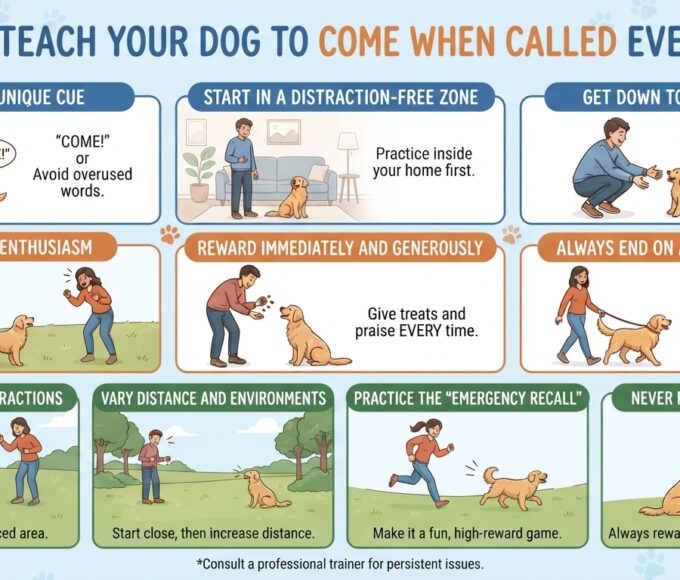
- “Come”
- “Touch”
- “Spin”
- “Place”
Avoid repeatedly changing the word for the same behavior.
If you use “down” one day and “lie down” the next, your dog may need additional learning before understanding that both cues mean the same thing.
Everyone in the household should ideally use the same cues and expectations.
8. Reward the Behavior You Want
Training isn’t just about correcting unwanted behavior. It’s also about noticing and rewarding desirable behavior when it happens naturally.
For example, if your dog calmly lies down while you’re working, you can quietly reward that calmness.
If your dog waits patiently rather than jumping on visitors, reinforce that behavior.
This teaches your pet that good choices are worthwhile even when you haven’t explicitly asked for a trick.
9. Gradually Reduce Treat Dependence
Treats are useful training tools, but your pet shouldn’t need to see a treat before responding to every cue.
Once your pet understands a behavior, start rewarding intermittently rather than every single time.
You can also use other rewards, such as:
- Praise
- Toys
- Play
- Permission to sniff
- Access to a favorite activity
However, don’t reduce rewards too quickly. If a behavior is still being learned, frequent reinforcement helps build reliability.
10. Practice Consistently
Consistency is one of the most important parts of training.
A dog that is rewarded for jumping on one family member but corrected for jumping on another may become confused.
Try to establish clear household rules.
For example, if you don’t want your dog jumping on guests, everyone should reinforce four paws on the floor rather than occasionally rewarding jumping with attention.
Regular practice is also more effective than a single long training session once a week.
11. Make Training Fun
Dogs are often more motivated when training feels like an enjoyable activity.
Use an enthusiastic voice, celebrate successful attempts, and include play between exercises.
You can turn training into games such as:
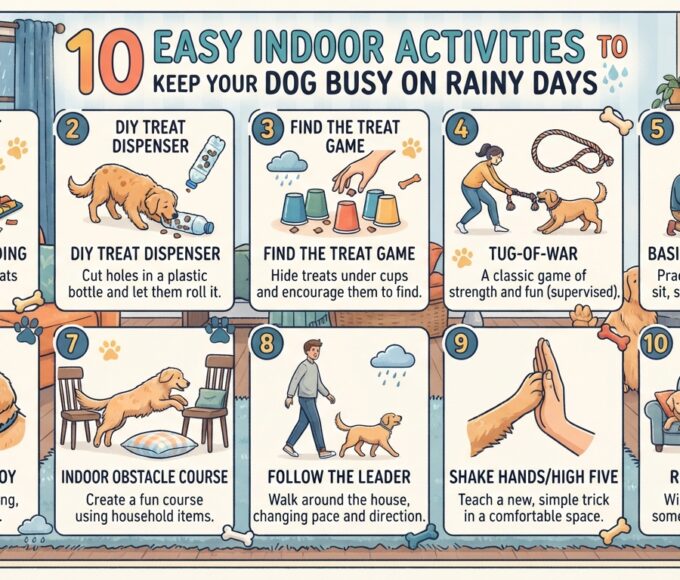
Find It
Hide treats around a safe room and encourage your dog to search.
Touch
Teach your dog to touch your hand with their nose.
Toy Cleanup
Gradually teach your dog to pick up a toy and place it in a basket.
Spin
Use a lure to guide your dog through a gentle circle and gradually add a verbal cue.
Target Training
Teach your dog to touch a designated object with their nose or paw.
Always choose tricks appropriate for your pet’s physical abilities.
12. Don’t Rush the Learning Process
Every animal learns at a different pace.
One dog might understand “spin” after several attempts, while another may need many sessions.
Avoid becoming frustrated when progress is slow.
Instead, ask:
Is the step too difficult?
If your dog repeatedly fails, make the exercise easier.
For example, if your dog can’t hold a “stay” for 20 seconds, return to two or three seconds and reward success.
Small wins build confidence.
13. Avoid Punishment-Based Training
Punishment can create fear, stress, or confusion and can damage the trust you’re trying to build.
Instead of focusing on punishing mistakes, concentrate on teaching your pet what you want them to do.
For example, if your dog jumps on you, rewarding calm behavior such as four paws on the floor gives them a clear alternative.
For serious behavior problems—particularly aggression, severe fear, or anxiety—consider working with a qualified, reward-based trainer or veterinary behavior professional.
14. Know When Your Pet Needs a Break
Sometimes the best training decision is to stop.
Signs your dog may be tired, frustrated, or overwhelmed can include:
- Walking away
- Excessive sniffing
- Losing interest in rewards
- Repeated mistakes
- Yawning
- Lip licking
- Pacing
- Becoming unusually restless
If your pet is struggling, take a break and try again later.
Training should build confidence rather than continually push your pet beyond their ability to cope.
15. Practice Tricks in Different Locations
A dog may perform perfectly in your living room but completely forget the behavior at the park.
This doesn’t necessarily mean your dog is being stubborn.
Dogs don’t automatically generalize every behavior to every environment.
Once a trick is learned at home, practice it in gradually different locations.
Change one factor at a time:
- Different room
- Garden
- Quiet outdoor location
- More distracting environment
Reward generously when your pet succeeds in a new setting.
16. Consider Your Pet’s Physical Abilities
Not every trick is suitable for every animal.
Avoid repeatedly asking a dog with joint problems to jump, for example. Puppies also need age-appropriate activities while their bodies develop.
If your pet has an orthopedic condition, neurological problem, pain, or another health concern, ask your veterinarian which exercises are appropriate.
A good trick should challenge your pet mentally without putting unnecessary physical strain on them.
Easy Tricks Beginners Can Teach
If you’re just getting started, consider beginning with simple behaviors such as:
- Sit
- Down
- Touch
- Shake
- Spin
- Wait
- Go to bed
- Find a toy
- Leave it
- Come when called
Once your pet understands basic training concepts, you can gradually move toward more complex behaviors.
A Simple 10-Minute Training Routine
You don’t need a complicated program.
Try something like this:
Minute 1–2: Warm-up with familiar cues.
Minute 3–5: Work on one new behavior.
Minute 6–7: Take a short play break.
Minute 8–9: Practice the behavior again.
Minute 10: Finish with an easy behavior your pet knows well and reward generously.
The exact duration isn’t important. Your pet’s attention, motivation, age, and individual needs should guide the session.
What If Your Pet Isn’t Learning?
If progress has stopped, don’t immediately assume your pet is unwilling to learn.
Consider whether:
- The reward is motivating enough.
- The environment is too distracting.
- The behavior is too difficult.
- Your timing is inconsistent.
- Training sessions are too long.
- Your cue isn’t clear.
- Your pet is tired or stressed.
- Your pet may be experiencing pain or another health problem.
Sometimes going back one step is all that’s needed.
If a behavior problem is persistent or potentially dangerous, professional help is worthwhile.
Frequently Asked Questions
How long does it take to teach a dog a new trick?
It depends on the behavior, the individual dog, previous training, motivation, and the training environment. Simple behaviors may develop quickly, while complicated tricks can take weeks or longer.
How often should I train my dog?
Short, regular sessions are generally easier for dogs to handle than occasional marathon sessions. Several brief practices throughout the day can work well.
Are treats necessary for training?
No. Treats are useful, but toys, praise, play, attention, and access to enjoyable activities can also serve as rewards.
What should I do if my dog keeps making mistakes?
Make the exercise easier. Break the behavior into smaller steps, reduce distractions, and reward successful attempts. Repeated mistakes often mean the current training step is too difficult.
Can older dogs learn new tricks?
Absolutely. Older dogs can learn new behaviors, although the pace may vary. Keep sessions appropriate for their physical abilities and consider any health limitations.
Is clicker training suitable for every dog?
Many dogs can learn with a clicker, but it isn’t mandatory. Some owners prefer verbal markers or other reward-based techniques. The most important factors are clear communication, good timing, consistency, and appropriate rewards.
Final Thoughts
Teaching your pet new tricks should be an enjoyable partnership rather than a test of obedience.
Use positive reinforcement, clear cues, appropriate rewards, short sessions, and gradual progression. Break complicated behaviors into manageable steps and give your pet plenty of opportunities to succeed.
Most importantly, remember that training isn’t just about producing an impressive trick.
Every successful training session gives you another opportunity to communicate with your pet, understand their behavior, build trust, and spend quality time together.
With patience and consistency, even a simple trick can become one of your favorite shared activities.
This Article Was Generated By AI.





Leave a comment