


Training is one of the most valuable things you can do for your pet. It isn’t simply about teaching a dog to sit on command or preventing a puppy from making a mess indoors. Good training helps pets understand what is expected of them, gives owners better ways to communicate, and can make everyday life safer and less stressful.
Whether you’re bringing home a young puppy, adopting an adult dog, or helping an older companion learn new routines, training is an ongoing process. Some pets learn quickly, while others need more repetition and patience.
The most effective approach focuses on rewarding desirable behavior, setting your pet up for success, and avoiding methods that create fear or unnecessary stress.
Here are the essential pet training skills every owner should understand.
1. Teach Basic Obedience Commands
Basic cues give you a simple way to communicate with your pet.
Useful commands include:
- Sit
- Down
- Stay
- Come
- Wait
- Leave it
- Drop it
Start with one skill at a time rather than trying to teach everything during a single session.
For example, when teaching “sit,” reward your dog immediately when their bottom touches the floor. With repetition, they begin to associate the word and action with the reward.
Keep early sessions short and engaging. Several brief sessions throughout the day can be more productive than one long training session.
2. Make House Training a Priority
For puppies, house training is one of the first major challenges.
The goal is to teach your pet where it is appropriate to eliminate and establish a predictable routine.
Take your puppy outside regularly, particularly:
- After waking up
- After eating or drinking
- After play
- Before bedtime
- After periods of excitement
When your puppy eliminates in the correct location, offer calm praise or another reward immediately.
Accidents are normal during the learning process. Punishing a puppy after an accident can create confusion or fear because the animal may not understand why you are upset.
Instead, clean accidents thoroughly and focus on preventing the next one through supervision and routine.
What About Adult Dogs?
Adult dogs can also need house-training after adoption, moving homes, illness, or changes in routine.
Don’t assume an adult dog is being deliberately difficult. Medical issues, anxiety, unfamiliar surroundings, or an inconsistent schedule can contribute to accidents.
If a previously house-trained dog suddenly begins having accidents, a veterinary check may be appropriate.
3. Teach Calm Leash Walking
Walking should be an enjoyable experience rather than a constant battle over the leash.
Start indoors or in a quiet area where there are fewer distractions.
Reward your dog for:
- Staying near you
- Checking in with you
- Walking with a loose leash
- Responding when you call their name
If your dog pulls toward something interesting, avoid turning the walk into a tug-of-war. Pause, create some distance from the distraction, and redirect their attention when possible.
A properly fitted harness or collar is important. The best equipment depends on the individual dog’s size, body shape, behavior, and walking style.
4. Socialize Your Pet Carefully
Socialization is often misunderstood as simply allowing a puppy to meet as many people and dogs as possible.
In reality, good socialization means helping your pet have calm, positive experiences with a variety of situations.
A puppy may gradually encounter:
- Different people
- Friendly, appropriately vaccinated dogs
- Household noises
- Cars
- Different surfaces
- Grooming equipment
- Visitors
- New environments
- Veterinary handling
The goal isn’t to force interaction. A nervous puppy should not be pushed toward a person, dog, or situation that frightens them.
Allow your pet to observe from a comfortable distance and reward calm behavior.
Quality Matters More Than Quantity
A single frightening experience can have a greater impact than several neutral experiences.
Keep introductions controlled, age-appropriate, and positive.
5. Introduce Crate Training Positively
A crate can provide a safe resting area and can be useful for transportation, veterinary visits, house-training, or short periods when a pet needs to be safely contained.
However, a crate should not be used as punishment.
Start by making the crate comfortable. You can place suitable bedding or a safe enrichment item inside and reward your pet for voluntarily entering.
Initially, keep the door open.
Once your pet is comfortable entering the crate, gradually introduce short periods with the door closed.
Increase the duration slowly while watching your pet’s behavior.
Never Use the Crate as a Long-Term Substitute for Exercise or Companionship
Dogs need opportunities to move, explore, interact, rest, and eliminate. Crate training should be one part of a broader care routine rather than a way to keep a dog confined for excessive periods.
6. Teach “Stay” and “Wait”
Although these cues are related, they can be useful in different situations.
“Stay” can mean remaining in a particular position until released.
“Wait” can be useful for temporary pauses, such as waiting before going through a door or getting out of a vehicle.
Begin with very short durations.
Ask your dog to stay, take one small step away, and immediately return and reward them if they remain in position.
Gradually increase:
- Duration
- Distance
- Distractions
Don’t increase all three at once.
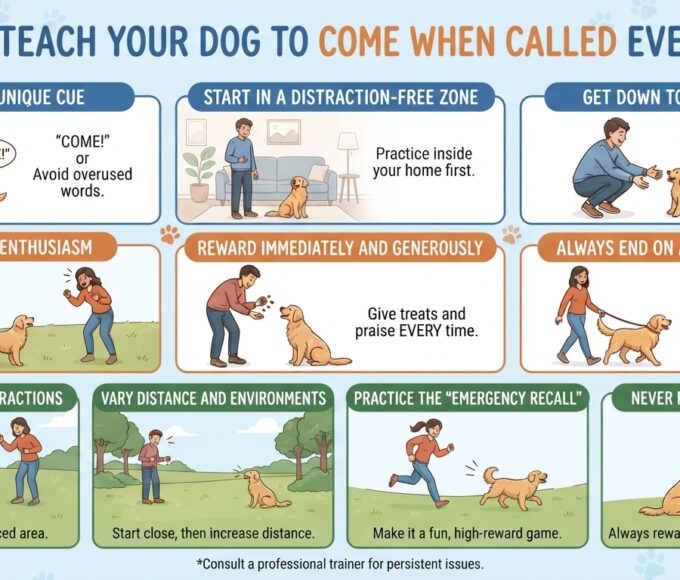
7. Build a Reliable Recall
A strong recall—teaching your dog to come when called—is one of the most important safety skills you can develop.
Start indoors or in a secure area.
Use an enthusiastic voice and reward your dog generously when they come toward you.
As reliability improves, practice in more distracting environments while using an appropriate leash or long line when necessary.
Avoid Calling Your Dog for Something They Dislike
If “come” repeatedly means bath time, nail trimming, or the end of all fun, your dog may become less enthusiastic about responding.
Whenever possible, make returning to you a rewarding experience.
And never use recall as an excuse to punish a dog for eventually coming back. You want your pet to learn that returning to you is safe.
8. Teach “Leave It”
Dogs naturally investigate the world with their noses and mouths.
Unfortunately, that can sometimes lead them toward dangerous objects.
“Leave it” teaches your dog to disengage from something before picking it up.
Begin with a low-value object and a high-value reward. When your dog stops trying to reach the object and turns toward you, reward them.
Gradually practice with different safe objects and environments.
This skill can potentially help prevent a dog from picking up:
- Food dropped on the ground
- Dangerous household objects
- Medication
- Toxic substances
- Sharp items
- Unknown objects outdoors
Training isn’t a substitute for supervision, but it provides another useful safety tool.
9. Teach “Drop It”
“Leave it” and “drop it” are different skills.
“Leave it” generally means don’t pick that up.
“Drop it” means release something already in your mouth.
This can be especially useful when your dog grabs something they shouldn’t have.
Avoid routinely chasing your dog around the house to retrieve objects. Chasing can turn the situation into a fun game of keep-away.
Instead, teach your dog that giving up an object results in something worthwhile.
You can begin with a toy and offer a treat or another appropriate toy as an exchange.
10. Use Positive Reinforcement
Positive reinforcement means rewarding a behavior you want to see repeated.
Rewards can include:
- Small treats
- Praise
- Play
- Toys
- Petting, when the animal enjoys it
- Access to something the pet wants
The reward should be meaningful to the individual animal.
For example, one dog may work enthusiastically for food while another may be more motivated by a favorite toy.
Reward Timing Matters
Try to reward the desired behavior immediately.
If several seconds pass before the reward, your pet may not understand exactly what earned it.
As the behavior becomes reliable, you can gradually reduce the frequency of food rewards while continuing to reinforce the behavior in other ways.
11. Train for Real-Life Situations
Training shouldn’t happen only in a quiet living room.
Once your pet understands a behavior, gradually practice it in different appropriate environments.
For example, a dog that reliably responds to “sit” at home may struggle to sit when surrounded by exciting smells, people, or other dogs.
That doesn’t necessarily mean the dog has forgotten the command.
The environment may simply be too distracting.
Increase distractions gradually and reward success.
12. Teach Your Pet to Handle Routine Care
An often-overlooked part of training is preparing pets for handling.
Dogs and cats may need their:
- Paws examined
- Ears checked
- Teeth brushed
- Nails trimmed
- Coat brushed
- Body examined
- Collar or harness adjusted
Introduce handling gradually and pair it with rewards.
For example, touch your dog’s paw briefly, reward them, and stop. Over time, you can gradually increase the duration.
This can make grooming and veterinary care less stressful.
13. Teach Calm Behavior
Not every useful behavior involves responding to a verbal command.
Learning how to relax is an important life skill.
Reward your pet for calm behavior such as:
- Lying quietly on a bed
- Settling beside you
- Remaining relaxed when visitors arrive
- Waiting calmly before meals
- Relaxing after play
If your dog becomes overly excited whenever someone knocks on the door, practice calm behavior during low-pressure situations before expecting perfect behavior when an actual visitor arrives.
14. Manage Jumping on People
Many dogs jump because they have learned that jumping produces attention.
Even telling a dog “no” can sometimes reinforce the behavior because the dog still receives interaction.
Instead, reward four paws on the floor.
Ask visitors to avoid encouraging jumping and reinforce calm greetings.
Consistency is especially important. If one person rewards jumping while another discourages it, your dog receives mixed signals.
15. Make Training Consistent
Consistency is one of the biggest factors in successful training.
Everyone in the household should understand the basic rules.
For example, if a dog isn’t allowed on the sofa, allowing it sometimes and correcting it at other times can create confusion.
Use the same cues and reward desirable behavior consistently.
Training becomes much easier when your pet doesn’t have to guess what different family members expect.
How Long Should Training Sessions Be?
Training sessions don’t need to be long.
For many dogs, short sessions of a few minutes can work well, particularly for puppies.
You can incorporate training naturally into daily activities:
- Ask for a sit before meals.
- Practice recall during safe play.
- Reward calm behavior when guests arrive.
- Practice waiting before opening a door.
- Ask for a simple cue before giving a toy.
These small moments can add up to significant progress.
Common Pet Training Mistakes to Avoid
Even well-intentioned owners can accidentally make training harder.
Expecting Instant Results
Learning is a process. Some behaviors may take days, while others require weeks or longer.
Repeating Commands Constantly
If you say “come, come, come, come” without your dog responding, the word can lose meaning.
Instead, improve the environment, distance, reward, or difficulty level.
Training When Your Pet Is Overwhelmed
A pet that is frightened, exhausted, extremely excited, or surrounded by overwhelming distractions may struggle to learn.
Make the situation easier.
Using Fear or Physical Punishment
Methods based on intimidation or physical punishment can damage trust and may increase fear or defensive behavior.
Reward-based training provides a way to teach desirable behavior while maintaining a positive relationship.
Ignoring Medical or Behavioral Problems
Not every behavior problem is simply a training issue.
Pain, illness, fear, anxiety, aging, and environmental changes can affect behavior.
If a sudden or serious behavior change occurs, consult a veterinarian. For complex behavior concerns, a qualified reward-based trainer or veterinary behavior professional may also be appropriate.
Can Older Pets Still Learn?
Absolutely.
Age doesn’t automatically prevent a dog or cat from learning new behaviors.
Older pets may require adjustments based on their physical abilities, previous experiences, hearing or vision changes, and health.
Keep sessions comfortable and avoid asking an older animal to perform physically demanding behaviors that could cause discomfort.
Training can also provide valuable mental stimulation for senior pets.
When Should You Get Professional Help?
Some problems are difficult to handle without guidance.
Consider seeking professional assistance if your pet shows:
- Serious aggression
- Severe fear
- Repeated escape attempts
- Significant separation-related distress
- Dangerous resource guarding
- Persistent destructive behavior
- Sudden major behavioral changes
Look for professionals who use humane, reward-based methods and who are willing to work with your veterinarian when medical factors may be involved.
Frequently Asked Questions
How long does it take to train a pet?
There is no universal timeline. Simple behaviors may be learned relatively quickly, while reliable behavior around distractions can take considerably longer. Training should be viewed as an ongoing process rather than a one-time project.
Can an older dog learn new commands?
Yes. Adult and senior dogs can learn new behaviors. Training may need to be adjusted around their previous experiences, physical abilities, and health.
What is the best reward for training?
The best reward is whatever your individual pet finds motivating. Small treats, toys, praise, play, and access to preferred activities can all work.
Should I punish my dog for making a mistake?
Punishment can create fear and confusion and may damage your relationship with your pet. Focus instead on preventing unwanted behavior, redirecting your pet, and rewarding the behavior you want.
How often should I train my pet?
Short, regular sessions are generally easier for pets to handle than occasional marathon sessions. You can also incorporate training into ordinary activities throughout the day.
What if my pet isn’t learning?
First, make the exercise easier. Reduce distractions, improve the reward, shorten the session, and check whether your pet understands what you’re asking. If progress remains difficult or there are serious behavior concerns, seek professional guidance.
Final Thoughts
Pet training is much more than teaching a collection of commands. It gives animals a way to understand our expectations while giving owners practical tools for communication and safety.
Focus on useful skills such as recall, leash walking, house training, socialization, handling, impulse control, and calm behavior. Keep sessions positive, practice consistently, and adjust the difficulty to your individual pet.
Most importantly, remember that training is a partnership. Your pet isn’t expected to understand everything immediately. With patience, appropriate rewards, clear communication, and realistic expectations, training can become one of the most rewarding parts of living with an animal companion.
This Article Was Generated By AI.






Leave a comment