


Your dog experiences the world largely through their nose. While humans depend heavily on sight, dogs use their incredible sense of smell to investigate their surroundings, identify familiar things, and discover new ones.
That makes scent games for dogs an excellent form of mental enrichment. A simple sniffing activity can encourage your dog to think, search, solve problems, and use some of their natural instincts.
The good news is that you don’t need expensive equipment or complicated training sessions. Many scent games can be created using treats, kibble, household objects, and toys you already have.
Here are five easy scent games you can try at home with your dog.
Why Are Scent Games Good for Dogs?
Sniffing isn’t just something dogs do on walks. It is an important part of how they explore and process their environment.
Scent-based activities can help:
- Provide mental stimulation
- Reduce boredom
- Encourage natural foraging behavior
- Give dogs an appropriate outlet for their energy
- Improve problem-solving skills
- Build confidence
- Make indoor time more interesting
- Add variety to your dog’s daily routine
For some dogs, a few minutes of focused sniffing can be surprisingly tiring because they’re concentrating on finding and identifying different scents.
1. Create a Treat Hunt Around Your Home
A treat hunt is one of the easiest ways to introduce your dog to scent games.
Start by choosing several small, dog-safe treats or pieces of your dog’s regular kibble. Ask your dog to stay in one room while you place a few rewards in another area.
For beginners, keep the hiding places relatively easy. Place treats near furniture, beside a toy, or in another location where your dog can safely reach them.
Then give your dog a cue such as “Find it!”
Let them explore and use their nose to locate the rewards.
How to Make the Game More Challenging
Once your dog understands the idea, gradually increase the difficulty.
You can:
- Hide treats in different rooms.
- Place rewards behind furniture.
- Use several areas of your home.
- Increase the distance between hiding spots.
- Reduce how easily the treats can be seen.
- Use fewer treats but make the search area larger.
Always make sure your dog can safely access every hiding place and avoid locations where they could knock something over or become trapped.
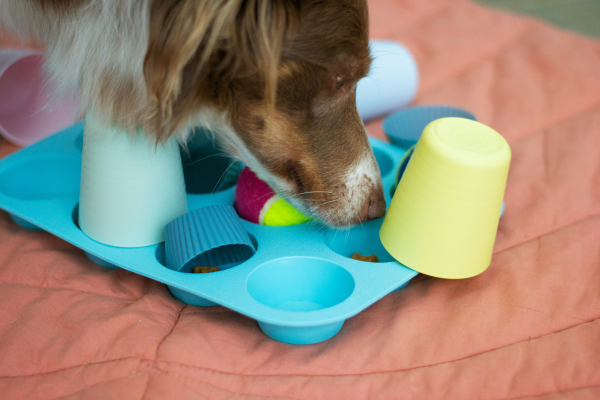
2. Try the Muffin Tin Game
A muffin tin can become a simple homemade puzzle game for your dog.
You’ll need:
- A clean muffin tin
- Small treats or pieces of kibble
- Tennis balls or suitable dog toys
Place a few treats into different sections of the muffin tin. Then cover the cups with tennis balls or appropriately sized toys.
Your dog will need to investigate the different cups and figure out how to move the objects to reach the rewards.
This activity combines scent work and problem-solving, giving your dog more to think about than simply eating a treat from a bowl.
Safety Tip
Only use objects that are too large for your dog to swallow. Supervise your dog throughout the activity, particularly if they are enthusiastic chewers.
If your dog isn’t interested in tennis balls, you can use suitable toys that fit securely over the muffin-tin cups.
3. Make a DIY Snuffle Box
You don’t necessarily need to buy a commercial snuffle mat to give your dog a sniffing challenge.
You can create a simple version using a laundry basket, storage container, or another sturdy dog-safe container.
Fill it with safe household items such as:
- Towels
- Blankets
- Fleece materials
- Dog toys
- Other clean, dog-safe objects
Then hide a few pieces of kibble or small treats throughout the container.
Encourage your dog to investigate the contents and search for the hidden food.
As your dog moves through the different materials, they will encounter different textures and scents while trying to locate the rewards.
Make It Easier for Beginners
If your dog is new to scent games, don’t bury the food too deeply. Start by placing rewards where they’re relatively easy to discover.
As your dog becomes more confident, you can make the search slightly more challenging.
Always supervise this activity and remove anything your dog attempts to chew or swallow.
4. Create a Treat Trail
Want to turn scent work into a little adventure?
Create a trail using small pieces of kibble or treats.
Start at one point in your home and place rewards along a hallway, around furniture, or toward another room. Leave enough space between some of the pieces so your dog has to actively follow the trail.
At the end, provide a slightly larger reward.
This activity encourages your dog to follow a scent rather than simply finding a treat that is sitting directly in front of them.
Take the Game Further
Once your dog understands the activity, you can make the trail more interesting by:
- Creating turns.
- Using a longer path.
- Changing the starting location.
- Adding safe obstacles.
- Ending the trail in a different room.
You can also combine the game with simple physical activities if your dog enjoys them.
Just remember that the goal is mental enrichment, not making the activity unnecessarily difficult.
5. Scatter Kibble Outside
If you have access to a safe, clean grassy area, try turning mealtime into a scent-searching activity.
Instead of placing all of your dog’s kibble in a bowl, scatter some of their regular food across an area of grass where it isn’t immediately visible.
Your dog can then use their nose to search for individual pieces.
This taps into natural foraging behavior while giving your dog an opportunity to explore their surroundings.
Keep Outdoor Scent Games Safe
Choose an area that is:
- Free from pesticides and other potentially harmful chemicals
- Free from rubbish or dangerous objects
- Safe from traffic
- Appropriate for your dog
- Clean enough for food-based enrichment
You should also avoid scattering food in areas where your dog might encounter something unsafe while searching.
How Often Should You Play Scent Games?
There isn’t one perfect schedule for every dog.
You can incorporate short scent activities into your dog’s daily routine, particularly when your dog needs additional mental stimulation.
Even a brief search can make an ordinary day more interesting.
Try rotating different games rather than repeating exactly the same activity every time. Changing the hiding locations, treats, objects, and search areas can help keep the experience fresh.
Use Your Dog’s Regular Food for Enrichment
You don’t always need extra treats to play scent games.
Using part of your dog’s normal daily kibble allowance can be a practical way to turn feeding time into enrichment.
For example, you could divide some of your dog’s meal between:
- A treat hunt
- A snuffle box
- A scent trail
- A supervised puzzle activity
This can make meals more engaging while helping you avoid adding excessive calories through additional treats.
Let Your Dog Sniff at Their Own Pace
When you’re playing scent games or taking your dog for a walk, give them opportunities to investigate scents rather than constantly rushing them from one location to another.
Sniffing is a natural behavior, and allowing dogs appropriate opportunities to explore with their noses can make walks and enrichment activities more rewarding.
You don’t need to turn every sniff into a training exercise. Sometimes simply giving your dog time to investigate is valuable enrichment on its own.
Final Thoughts
Scent games for dogs are a simple and inexpensive way to make your dog’s day more interesting.
A treat hunt, muffin tin puzzle, homemade snuffle box, treat trail, or outdoor kibble search can encourage your dog to use their natural sense of smell while providing mental stimulation.
The key is to start with an activity your dog can easily understand and gradually increase the challenge as they become more confident.
Most importantly, keep every game safe, supervise your dog when necessary, and make sure the activity remains fun. A few minutes of nose work can turn ordinary treats and household items into an engaging adventure for your four-legged friend.




Leave a comment