





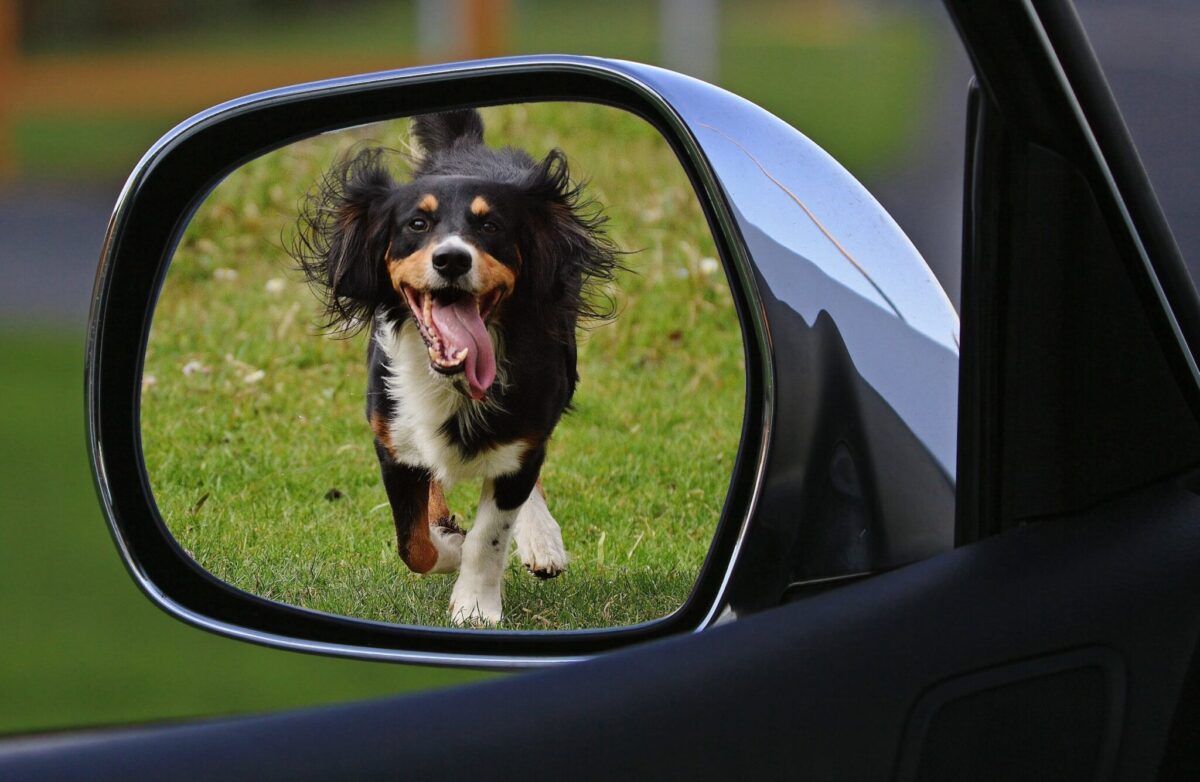
Have you ever watched your dog encounter a mirror for the first time?
Some dogs bark at their reflection. Others sniff around the mirror, tilt their heads, investigate for a few seconds, or simply walk away as if nothing happened.
To us, the explanation seems obvious: that’s your dog looking back at them.
But dogs don’t necessarily experience a reflection the same way humans do.
Their sensory priorities, particularly their extraordinary sense of smell, are different from ours. They also don’t need to understand mirrors in order to navigate their everyday world.
Here are 12 reasons a dog may not treat its reflection as a representation of itself.
1. Dogs Depend Heavily on Smell
Vision is important to dogs, but smell plays an enormous role in how they investigate and identify their surroundings.
When a dog encounters another animal, scent provides information that a visual image alone cannot provide.
A reflection creates a strange sensory mismatch.
Your dog sees another dog-like figure, but there is no corresponding scent coming from the other side of the glass.
That may make the reflection difficult to interpret.
2. The Reflection Has No Smell
Imagine seeing what looks like another dog but being unable to smell it.
That’s essentially one of the strange features of a mirror encounter from a dog’s perspective.
Dogs use scent to gather information about other animals and their environment. A mirror provides none of that information.
The image may therefore be interesting for a moment but fail to behave like a genuine animal encounter.
3. Mirror Self-Recognition Isn’t Necessarily a Dog’s Strength
Humans commonly recognize themselves in mirrors, but self-recognition can vary considerably across animal species.
The traditional “mirror test” is one method scientists have used to study self-recognition, but it doesn’t necessarily capture every form of animal self-awareness.
A dog failing to respond to a reflection as “me” doesn’t mean the dog lacks awareness or intelligence.
It may simply mean that visual mirror recognition isn’t particularly meaningful to that species.
4. Dogs Have No Practical Need to Understand Mirrors
Humans interact with mirrors constantly.
We use them to check our appearance, adjust clothing, apply makeup, shave, and perform countless other tasks.
Dogs don’t have these reasons to understand reflective surfaces.
A dog can successfully navigate its environment without knowing that a mirror produces a visual duplicate of whatever stands in front of it.
Without a practical reason to learn the concept, the reflection may simply remain an unusual environmental feature.
5. The Reflection Doesn’t Behave Like a Real Dog
A real dog can respond independently.
It might approach, move away, sniff, play, bark, or change its body language.
A reflection simply copies what the dog does.
If your dog moves forward, the reflected dog moves forward.
If your dog turns its head, the reflected dog does exactly the same thing.
That predictable imitation doesn’t provide the independent social responses dogs normally receive from another animal.
6. There’s No Scent or Physical Interaction
Dogs investigating another animal typically have multiple ways to gather information.
They can sniff it, observe its movements, listen to its sounds, and potentially interact physically.
A mirror offers only visual information.
Your dog may approach the reflected image expecting additional information and then discover that nothing happens.
After repeated experiences, the reflection may become less interesting.
7. Dogs Experience the World Through Multiple Senses
Dogs don’t rely on vision alone.
They combine information from smell, hearing, touch, taste, and sight to understand what’s happening around them.
A mirror provides an unusually limited experience.
Your dog can see something that looks like another animal, but there is no matching scent or physical presence.
That sensory inconsistency may explain why some dogs investigate briefly and then lose interest.
8. Their Vision Is Different From Ours
Dogs don’t see the world exactly as humans do.
They have different visual abilities, including differences in color perception and visual acuity.
That doesn’t mean dogs see mirrors as blurry or meaningless. They can clearly respond to visual movement and recognize familiar objects and individuals.
However, visual information may not carry exactly the same significance for them as it does for humans.
A reflection is therefore only one small piece of information rather than a complete sensory encounter.
9. Some Dogs Quickly Learn That the Reflection Isn’t Important
Dogs are excellent observers of patterns.
A puppy might initially bark at a reflection because it appears to be another animal. After repeated encounters, the dog may discover that nothing interesting ever comes from the other side of the mirror.
Eventually, the dog may stop reacting.
This can look like the dog has suddenly “understood the mirror,” although we can’t know exactly what mental representation the dog has formed.
The simplest explanation may be that the reflection has become predictable and unimportant.
10. Individual Dogs React Differently
Not every dog responds to mirrors in the same way.
One dog may bark repeatedly.
Another might sniff the floor beneath the mirror.
A puppy could attempt to play with the reflection.
Another dog may glance at it and immediately return to its favorite toy.
Age, previous experiences, personality, environment, and individual sensory preferences can all influence the response.
There isn’t one universal “dog reaction” to mirrors.
11. Puppies May Be More Curious
Young dogs often investigate unfamiliar objects and experiences.
A puppy seeing a reflection may initially treat it as something worth exploring.
They might:
- Bark at the image
- Tilt their head
- Look behind the mirror
- Paw at the glass
- Sniff the floor
- Move from side to side
- Try to initiate play
With repeated exposure, many puppies simply lose interest.
That’s not necessarily a sign that something is wrong. The mirror may simply stop being novel.
12. Sometimes the Reflection Just Isn’t Interesting
Perhaps the simplest explanation is also one of the most amusing.
Your dog may simply not care.
If the reflected dog doesn’t smell interesting, respond independently, provide food, offer a toy, or create any meaningful interaction, why spend the afternoon staring at it?
Dogs constantly make decisions about which things deserve their attention.
For many dogs, a mirror eventually falls into the “boring household object” category.
Why Do Some Dogs Bark at Mirrors?
If some dogs don’t recognize their reflections, why do others bark at them?
A reflection can initially look like an unfamiliar dog.
The sudden appearance of another animal inside the home may trigger curiosity, excitement, play behavior, or alertness.
Some dogs may also react because the reflection copies their movements in a way they haven’t encountered before.
Over time, repeated exposure may reduce the reaction.
If a dog becomes extremely distressed around mirrors, however, there’s no reason to force continued interaction. Simply giving the dog space is usually enough.
Why Do Some Dogs Ignore Their Reflection Completely?
Ignoring a reflection can be completely normal.
After seeing the same image repeatedly without receiving meaningful sensory feedback, a dog may decide that the mirror isn’t worth investigating.
This is similar to how dogs can eventually stop reacting to harmless background sounds or familiar objects.
What initially attracts attention doesn’t necessarily remain interesting forever.
Can Dogs Recognize Themselves in Other Ways?
This is where the topic becomes especially interesting.
A dog’s understanding of itself doesn’t have to depend on looking into a mirror.
Dogs have an extraordinarily strong sense of smell, and researchers have explored whether dogs can distinguish their own odor from the scents of other dogs.
That suggests that asking whether a dog has “self-awareness” based only on a mirror may be too simplistic.
Dogs experience and interact with the world through a sensory system very different from ours.
Should You Test Your Dog With a Mirror?
You can safely allow your dog to investigate a normal household mirror if the dog is comfortable around it.
Let your dog approach at their own pace.
Don’t force their face toward the mirror or repeatedly encourage them to interact with their reflection.
If your dog becomes frightened, frustrated, or overly excited, simply redirect them to another activity.
A mirror should be an interesting environmental object—not a test your dog needs to pass.
The Fascinating World of Canine Perception
A dog’s reaction to a mirror gives us a small glimpse into how differently dogs experience the world.
Humans naturally prioritize visual information, while dogs place enormous importance on scent and other sensory signals.
That means something obvious to us can be surprisingly ambiguous to them.
Your dog may never stare into a mirror and think, “That’s me.”
And that’s perfectly fine.
They have an entirely different way of understanding the world around them.
Final Thoughts
Dogs may bark at, investigate, ignore, or eventually become completely uninterested in their reflections.
Their reactions can be influenced by smell, visual information, previous experiences, age, personality, and the fact that a reflection doesn’t behave like a real social partner.
Rather than assuming that every dog simply “doesn’t recognize itself,” it’s more accurate to say that mirror self-recognition isn’t as straightforward in dogs as it is in humans.
So if your dog walks past a mirror without a second glance, don’t worry.
There may simply be more important things to investigate—like what’s happening in the kitchen, where the treats are, or whether someone is preparing for a walk.








Leave a comment