





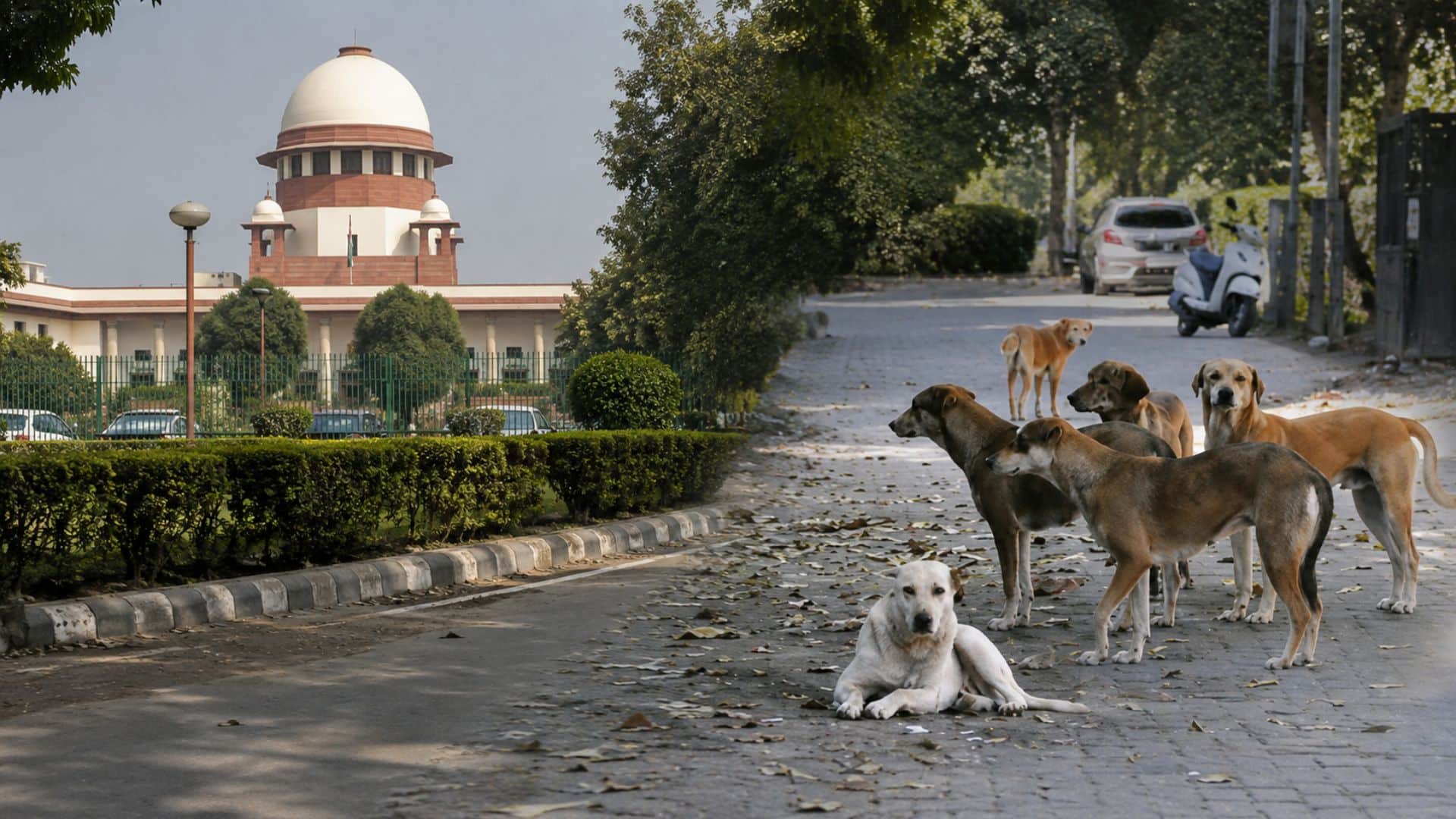
The Supreme Court on May 25, 2026, declined to entertain an NGO’s request for an urgent clarification concerning remarks attributed to Punjab Chief Minister Bhagwant Mann following the Court’s May 19 order in the stray dog case.
The NGO, Animals Are People Too, had approached the Supreme Court over concerns that the May 19 judgment could be interpreted as permitting indiscriminate killing of stray dogs. The bench of Justices Vikram Nath and Sandeep Mehta directed the petitioner to approach the Punjab and Haryana High Court, noting that the High Courts had been given a role in monitoring compliance with the Supreme Court’s directions.
The development has drawn attention to an important distinction between what the Supreme Court’s order actually permits and how political or administrative statements may characterize it.
Why Did the NGO Approach the Supreme Court?
According to reports, advocate Anil Kumar Mishra, appearing for the NGO, raised concerns about statements attributed to Punjab Chief Minister Bhagwant Mann after the Supreme Court’s May 19 order.
The application sought clarification that the Court’s directions concerning euthanasia of certain dogs should not be interpreted as authorization for the indiscriminate killing of healthy stray dogs.
The counsel reportedly referred to Mann’s public statement about a campaign targeting stray dogs and argued that the Supreme Court’s ruling was being interpreted too broadly.
The bench, however, declined to take up the request and directed the petitioner toward the Punjab and Haryana High Court.
What Did the Supreme Court’s May 19 Order Say?
The May 19, 2026 judgment addressed the public-safety concerns surrounding stray and feral dogs and the need for authorities to deal with dogs presenting particular risks.
The judgment discusses situations involving dogs that are rabid, incurably ill, or dangerous/aggressive. It also refers to veterinary assessment and compliance with applicable animal-welfare laws.
This is significant because the ruling should not simply be summarized as a general authorization to kill every stray dog.
Legal reporting following the judgment similarly noted that the decision did not amount to a blanket permission for citizens or authorities to randomly pick up, relocate, or kill stray dogs. The applicable statutory safeguards and veterinary procedures remain relevant.
The Key Distinction
There is an important difference between:
- Action against a dog determined to be rabid or otherwise covered by the Court’s directions.
- The indiscriminate removal or killing of healthy stray dogs.
- Measures designed to address genuine public-safety risks while complying with animal-welfare requirements.
The Supreme Court’s judgment has to be read together with the conditions and legal procedures contained within it rather than reduced to a single political statement or slogan.
What Did Bhagwant Mann Say?
Following the Supreme Court’s May 19 order, Punjab Chief Minister Bhagwant Mann publicly discussed action against stray dogs.
Reports quoted his statement as announcing a campaign concerning stray dogs considered dangerous to children and people using public spaces. The statement became the basis for the NGO’s request for clarification, with the organization arguing that the wording could lead to an overly broad interpretation of the Court’s judgment.
The Supreme Court did not, however, modify its May 19 order during the May 25 hearing.
Justice Vikram Nath questioned whether a Chief Minister’s public statement, by itself, required the Supreme Court to change its judicial order. The bench instead directed the petitioner to pursue the issue before the Punjab and Haryana High Court.
Why Was the Petition Sent to the High Court?
The Supreme Court had already allowed the concerned High Courts to monitor compliance with its directions in the stray dog proceedings.
That was the basis for directing the NGO to approach the Punjab and Haryana High Court rather than seeking an immediate clarification from the Supreme Court.
This means the May 25 development was primarily about which court should address the petitioner’s implementation-related concern, rather than a new Supreme Court ruling authorizing a broader dog-culling campaign.
Public Safety and Animal Welfare Remain Connected Issues
The stray dog debate involves two concerns that frequently appear together: public safety and animal welfare.
Dog-bite incidents and attacks, particularly those involving children, are genuine public-health and safety concerns. The Supreme Court’s May 19 judgment itself placed considerable emphasis on the risks posed by dangerous and feral dogs.
At the same time, India’s animal-control framework contains procedures governing how stray and community dogs are handled.
The challenge for authorities is therefore not simply whether action should be taken, but what action is legally permitted, which dogs are covered, who is authorized to act, and what veterinary and statutory procedures must be followed.
What Happens Next?
The NGO was directed to pursue its concerns before the Punjab and Haryana High Court.
That court therefore becomes an important forum for questions concerning implementation of the Supreme Court’s directions in Punjab and the interpretation of actions taken by state and local authorities.
The Supreme Court’s May 25 decision did not itself announce a new statewide policy for Punjab. Instead, it left the petitioner to pursue the matter through the High Court mechanism already available for monitoring compliance.
Why the Wording of Court Orders Matters
The controversy also illustrates why judicial orders need to be read in their entirety.
A court may establish conditions, exceptions, procedural safeguards, and responsibilities for different authorities. Summarizing such an order as a general permission to remove or kill all animals of a particular category can omit important legal limitations.
In this case, reporting on the May 19 judgment emphasized that the Court’s directions concerning euthanasia were tied to specified circumstances and legal safeguards rather than being an unrestricted authorization for killing stray dogs.
A Continuing Debate Over Stray Dog Management
India’s stray-dog debate extends well beyond this particular case. Governments and courts have had to balance concerns about dog bites, rabies, public spaces, animal population management, and animal welfare.
The Supreme Court’s May 2026 proceedings form part of that broader legal debate.
For animal-welfare groups, the focus remains on ensuring that court directions are implemented according to their actual terms. For governments and members of the public, the central concern includes preventing attacks and maintaining safe public spaces.
Both issues can be addressed only through clear procedures and lawful implementation.
Final Takeaway
The Supreme Court did not entertain the NGO’s request for an urgent clarification concerning Punjab Chief Minister Bhagwant Mann’s remarks on May 25, 2026. Instead, the bench directed the organization to approach the Punjab and Haryana High Court.
The May 19 Supreme Court judgment dealt with dangerous, rabid, or incurably ill dogs under specified conditions and included legal and veterinary safeguards. It should not be reduced to a blanket statement that all stray dogs may be killed.
The next stage therefore concerns how those directions are interpreted and implemented at the state and local levels. The Punjab and Haryana High Court’s role in monitoring compliance remains particularly relevant to that question.












Leave a comment