



Dogs have a special talent for turning ordinary moments into something hilarious. One minute they are calmly relaxing, and the next they are racing around the house, stealing a sock, or staring at you as if they have an important question to ask.
Every dog has its own personality and collection of quirky habits. Some behaviors are playful, some are attention-seeking, and others simply seem ridiculous from a human perspective.
Here are nine funny dog habits that can make everyday life with your four-legged companion much more entertaining.
1. The Legendary Zoomies
Few things are more entertaining than watching a dog suddenly explode into a burst of energy.
These episodes are commonly called zoomies, or frenetic random activity periods. A dog may sprint across the yard, race around the living room, spin in circles, or make several laps around the house before suddenly settling down.
Zoomies can happen after exciting events, playtime, grooming, or simply when a dog has accumulated some extra energy.
Watching a happy dog race around with a loose, playful body can be hilarious, but make sure the area is safe. Slippery floors, stairs, sharp furniture, and obstacles can turn an amusing sprint into an injury.
2. Chasing Their Own Tail
Some dogs seem convinced that their tail is the most fascinating toy in the world.
They may spin repeatedly, jump toward it, or chase it around in circles. Puppies may do this while discovering their bodies and learning how everything moves.
Occasional tail chasing can simply be playful behavior.
However, frequent or obsessive tail chasing deserves more attention. Fleas, skin irritation, allergies, pain, or other medical and behavioral issues can sometimes contribute to excessive chasing or biting of the tail.
So enjoy the funny spinning when it happens—but pay attention if the behavior suddenly becomes intense or difficult for your dog to stop.
3. The Dramatic “Play Dead” Performance
Some dogs are natural actors.
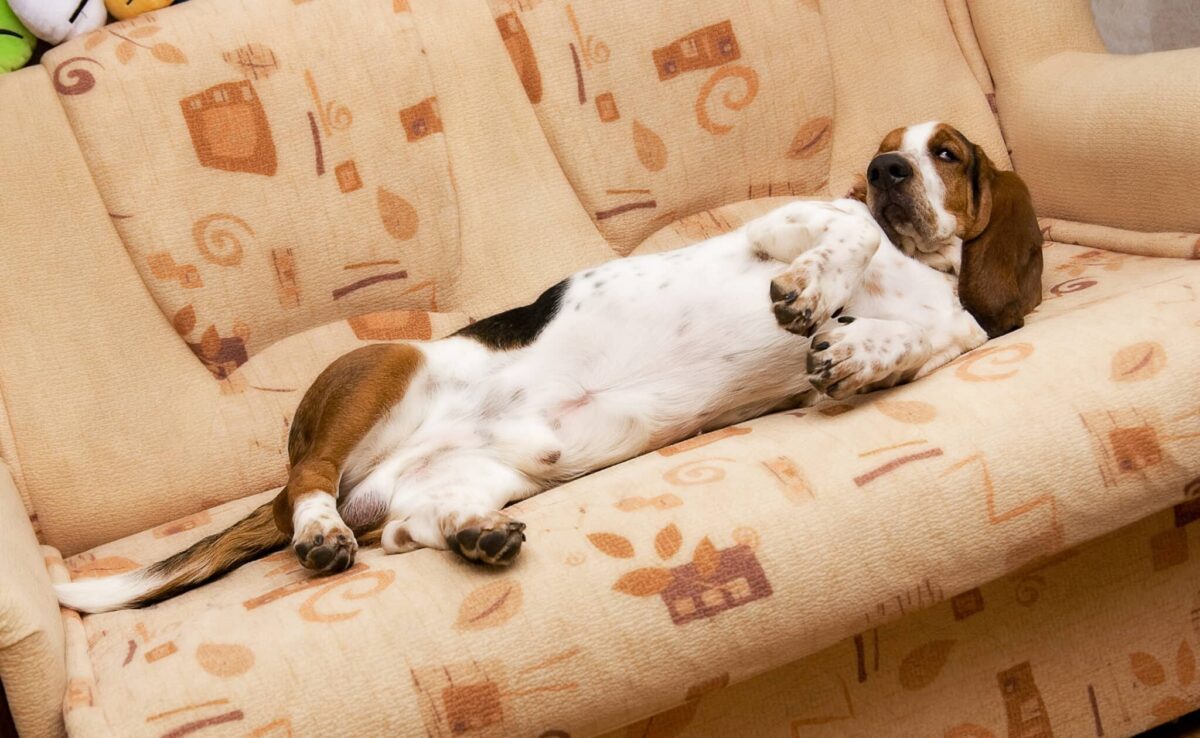
After learning a cue such as “play dead,” they may dramatically flop onto their side or back and remain completely still until they receive their reward.
Other dogs simply enjoy rolling onto their backs while relaxing or playing.
A dog lying on its back can have several meanings depending on the context. It may be relaxed, inviting interaction, or communicating uncertainty. That’s why it’s better to look at the dog’s entire body language rather than assuming every belly-up position means the same thing.
Still, when a dog has mastered the theatrical flop, the performance can be difficult not to laugh at.
4. The Blanket Burrito
Some dogs don’t simply sleep on blankets.
They become the blanket.
A dog may burrow underneath a soft blanket until only its nose, ears, or eyes are visible. Others somehow manage to wrap themselves into what looks like a perfectly assembled furry burrito.
Dogs may seek blankets because they provide warmth, comfort, or a cozy place to rest. Some also seem to enjoy burrowing as part of their natural preference for enclosed or comfortable sleeping spaces.
Just make sure your dog can easily get out and isn’t overheating or becoming tangled.
5. The Sneaky Sock Thief
If socks mysteriously disappear in your house, your dog may be the prime suspect.
Many dogs find socks interesting because they carry strong household and human scents. The fabric is also easy to grab and carry, making it an attractive object for some dogs.
The funniest part often comes after the theft.
Your dog grabs one sock, looks directly at you, and suddenly takes off as though they have just stolen something extremely valuable.
It’s entertaining—but don’t let the joke become a habit. Socks can be dangerous if swallowed because fabric can cause an intestinal blockage.
Instead of chasing your dog, teach a reliable “drop it” or “leave it” cue and exchange the sock for an appropriate toy or treat.
6. The “Why Are You Crying?” Routine
Some dogs become noticeably interested when they hear crying or distressed sounds.
A dog may walk over, tilt its head, stare at the person, whine softly, or stay nearby.
They may also react to crying sounds coming from a television, phone, or another room.
Dogs are highly attentive to sounds, body movements, facial expressions, and changes in familiar routines. Some may respond by approaching, while others may become unsettled or simply observe from a distance.
Although we can’t know exactly what a dog is thinking, their concerned-looking expressions can certainly make these moments memorable.
If your dog approaches someone who is upset, allow the interaction to remain comfortable for both the person and the dog. Not every dog wants close contact, especially when the situation is unfamiliar.
7. Barking at Absolutely Nothing
Every dog owner has probably experienced this moment.
Your dog suddenly looks toward an empty corner and starts barking.
You look.
Nothing.
Your dog looks again.
Still nothing.
Then comes another series of determined woofs.
Dogs have much sharper senses of hearing and smell than humans, so they may notice sounds, scents, or movement that we don’t detect. A passing animal outside, a distant noise, plumbing sounds, or movement behind a wall could capture their attention.
Rather than assuming your dog is barking at something supernatural, consider what might be triggering the behavior.
If unexpected barking becomes frequent, intense, or difficult to interrupt, look for patterns and consider discussing persistent changes with a veterinarian or qualified behavior professional.
8. The “Guilty” Face After Mischief
You come home and discover that the trash has been investigated, a cushion has been rearranged, or a shoe has mysteriously become a chew toy.
Your dog looks at you.
Head lowered.
Eyes turned away.
Body slightly crouched.
It certainly looks like guilt.
However, what people call the “guilty look” is better understood as a dog’s response to human behavior and the situation around them. Research and behavior observations suggest that these body postures don’t necessarily mean a dog understands that it has committed a moral wrongdoing in the human sense.
A dog may be responding to your tone, posture, facial expression, or the unusual situation.
The lesson is simple: instead of relying on punishment after the fact, manage access to tempting objects and reward desirable behavior when you catch your dog doing something right.
9. The Post-Walk Stare
You return from a walk.
Your dog drinks some water.
Then they sit down and stare directly at you.
The message seems obvious:
“So… what’s next?”
Some dogs may expect food, play, another activity, or simply more interaction with their favorite person.
Dogs quickly learn household routines. If a walk is regularly followed by a treat, game, meal, or rest on the couch, they may begin anticipating what comes next.
That intense stare can be especially funny when your dog has already completed a long walk and looks as though they are waiting for you to produce another exciting activity.
Sometimes, though, the best answer really is a comfortable bed and a good nap.
Why Are Dogs So Funny?
Dogs don’t need to perform tricks to entertain us.
Their everyday behavior can be funny because dogs interact with the world differently from humans. They investigate strange objects, follow routines, react to unfamiliar sounds, become excited about simple games, and develop individual habits that seem completely unique to them.
Their personalities make the difference.
One dog may be obsessed with socks. Another may prefer blankets. One might perform spectacular zoomies every evening, while another specializes in dramatic staring contests.
When a Funny Habit Could Mean Something More
Most quirky behaviors are harmless, especially when they happen occasionally and your dog otherwise seems comfortable.
But a sudden change in behavior shouldn’t automatically be dismissed as funny.
Talk with your veterinarian if you notice things such as:
- Repetitive or obsessive tail chasing
- Sudden excessive vocalization
- Repeated chewing or licking of the body
- Signs of pain or discomfort
- Difficulty settling down
- Sudden changes in appetite or energy
- Confusion or unusual behavior
- Attempts to swallow non-food objects
A behavior that looks amusing from the outside can sometimes be a sign that something is bothering your dog.
Let Your Dog Be Their Weird Self
One of the best parts of sharing your life with a dog is discovering all the little habits that make them unique.
Maybe your dog performs zoomies after every bath. Maybe they steal socks whenever you’re not looking. Maybe they turn themselves into a blanket burrito or stare at you after every walk as though you’ve forgotten an important part of the schedule.
These silly moments become part of everyday life—and often become the memories we treasure most.
Dogs may not always make sense to us, but their strange little personalities are exactly what makes living with them so much fun.
Final Thoughts
From tail chasing and zoomies to sock stealing and dramatic staring contests, dogs have countless ways of making us laugh.
Their funny habits are often part of normal exploration, play, communication, or learned routines. By paying attention to the context and your dog’s body language, you can enjoy the entertaining moments while recognizing when a behavior might need professional attention.
Sometimes, you don’t need an exciting adventure to have a great day.
You just need a dog who suddenly decides to run around the house like a furry race car.
This Article Was Generated By AI.




Leave a comment