





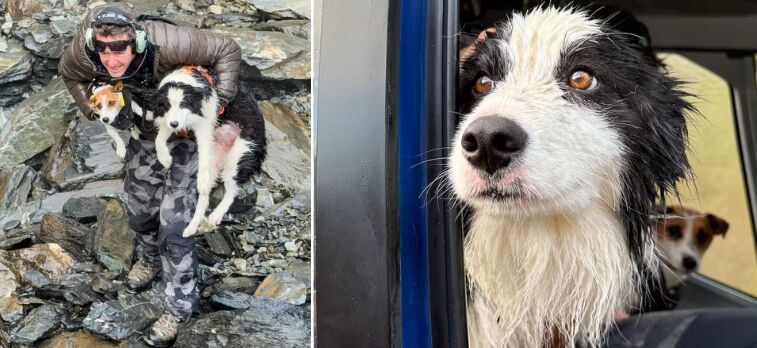
When Jessica went hiking with her Border Collie, Molly, she never expected the trip to end with a serious accident and a desperate search for her dog.
Jessica fell nearly 180 feet down a waterfall in a remote part of New Zealand and suffered multiple injuries. Rescue crews managed to reach her and airlift her to safety, but Molly disappeared into the surrounding wilderness.
For seven days, nobody knew whether the dog was still alive.
Then, an aerial search using thermal-imaging equipment detected a heat signature near the area where the accident had happened. What followed was a remarkable rescue that finally brought Molly back to her owner.
A Fall That Changed Everything
Jessica had been hiking through a remote and rugged area of New Zealand when she slipped and fell down a waterfall.
The fall was approximately 180 feet, leaving her with multiple injuries that required emergency assistance.
Rescuers arrived and transported Jessica to safety by helicopter. But when the immediate emergency was over, there was another problem.
Molly was nowhere to be found.
The Border Collie had disappeared into the difficult terrain surrounding the waterfall.
The landscape was remote, steep, and challenging to search, making the chances of finding a missing dog increasingly uncertain.
A Helicopter Pilot Refused to Give Up
Matt Newton was one of the helicopter pilots involved in Jessica’s initial rescue.
Although the emergency mission was over, Newton couldn’t stop thinking about Molly.
He returned to the area several times to look for her. Unfortunately, the early searches did not locate the dog.
Instead of giving up, Newton and his family decided to ask the public for help.
They launched a fundraiser to cover the cost of continuing the search, including additional helicopter time and specialized equipment.
The response was far greater than expected.
Strangers Came Together to Help Molly
People across New Zealand began donating to the search despite having no personal connection to Jessica or Molly.
More than NZ$11,000 was raised.
The money helped extend the search and made it possible to use thermal-imaging technology during aerial searches.
For a missing dog in such difficult terrain, the equipment could make a significant difference. Instead of relying only on visual searches from the air, rescuers could look for signs of body heat from above.
After days of uncertainty, that technology finally produced a result.
Molly Was Found Alive
During an aerial search over the area around the waterfall, thermal imaging detected a heat signature.
The team investigated the location and eventually confirmed what everyone had been hoping for.
It was Molly.
She was still alive, approximately in the area where Jessica’s accident had occurred.
After seven days alone in the wilderness, the Border Collie had survived.
The discovery immediately changed the mission from a search operation into a rescue.
A Dangerous Rescue From the Air
Finding Molly was only the beginning.
The terrain made reaching her difficult, so rescuers needed to carefully plan how to get her out.
A volunteer was lowered to the location with a trained rescue dog to help reach Molly and prepare her for extraction.
The operation eventually brought Molly safely to the helicopter.
After spending a full week outdoors without her owner, Molly was reportedly in surprisingly stable condition.
Her survival was an extraordinary outcome considering the rugged environment and the uncertainty surrounding her whereabouts.
Molly Finally Reunites With Jessica
After being rescued, Molly was taken to the hospital where Jessica was still recovering from her injuries.
The two were finally together again after seven days apart.
The reunion marked the end of an emotional search that had involved rescuers, volunteers, pilots, donors, and strangers who had simply wanted to help bring a missing dog home.
For Jessica, seeing Molly again meant that one part of an already difficult experience had finally ended with good news.
Thousands of People Helped Make the Rescue Possible
Molly’s rescue was not the work of one person.
Newton continued searching after the initial attempts failed. His family helped organize the fundraiser. Donors contributed thousands of dollars. Volunteers participated in the search and rescue operation, while specialized equipment helped locate Molly from the air.
Most of these people had never met Jessica or Molly.
Their involvement demonstrates how quickly strangers can come together when a missing animal needs help.
How Molly Survived for Seven Days
Molly’s ability to survive alone for a week in such challenging surroundings is one of the most remarkable parts of the story.
However, exactly how she managed those seven days is not fully known.
Dogs can sometimes survive unexpectedly long periods outdoors, depending on factors such as weather, access to water, shelter, their physical condition, and the surrounding environment.
Molly’s location and circumstances undoubtedly presented serious challenges, making her eventual discovery all the more significant.
A Rescue That Started With Hope
For several days, there was no guarantee that Molly would be found.
The initial searches had produced nothing, and the surrounding terrain made the operation extremely difficult.
But Newton continued looking, the public responded to the fundraiser, and rescuers eventually gained access to technology that helped locate Molly.
The search could easily have ended without an answer.
Instead, the team found a heat signature in the wilderness—and it turned out to be the missing dog everyone had been searching for.
Frequently Asked Questions
Who is Molly?
Molly is a Border Collie who became separated from her owner after Jessica fell down a waterfall while hiking in New Zealand.
How long was Molly missing?
Molly spent approximately seven days alone in the New Zealand wilderness before rescuers found her.
How was Molly found?
An aerial search using thermal-imaging equipment detected a heat signature in the area where Jessica’s accident had occurred. The team later confirmed that the heat signature was Molly.
How did rescuers reach Molly?
A volunteer was lowered to the difficult location with a trained rescue dog to help reach Molly and bring her to the waiting helicopter.
How much money was raised for Molly’s search?
More than NZ$11,000 was raised by people supporting the continued search.
Did Molly survive?
Yes. Molly was found alive after seven days and was successfully rescued from the wilderness.
Conclusion
Molly’s disappearance could have ended very differently.
After Jessica’s accident, the Border Collie vanished into a remote and challenging landscape. For a week, there was no certainty that rescuers would ever find her.
But one pilot continued searching, strangers contributed to the effort, volunteers joined the operation, and thermal-imaging technology eventually helped locate the missing dog.
Molly’s safe rescue brought an emotional end to a week of uncertainty and reunited her with the person she had been separated from.
Sometimes, finding a lost dog takes more than one search team. It takes persistence, technology, volunteers, and people willing to keep looking when the outcome is far from certain.








Leave a comment