



There is something undeniably impressive about sharing your home with a large dog. Whether it’s the calm presence of a Great Dane, the strength of a Rottweiler, the affectionate nature of a Newfoundland, or the fluffy appearance of a Bernese Mountain Dog, big dogs often make a memorable impression.
But their appeal isn’t simply about size.
Many large dogs can be affectionate, loyal, intelligent, playful, and deeply connected to their families. Some are happiest relaxing beside their people, while others have working backgrounds that make them eager to exercise, learn, and stay busy.
At the same time, owning a large dog comes with responsibilities that shouldn’t be overlooked. Bigger bodies mean bigger equipment, higher food costs, more physical strength to manage, and sometimes greater health considerations.
So, what makes large dogs such appealing companions—and what should prospective owners know before bringing one home?
Why Large Dogs Have Such a Strong Appeal
Large dogs often have a noticeable presence wherever they go.
Their size can make them appear imposing, but physical size doesn’t automatically determine personality. Some of the biggest breeds are known for being affectionate and relaxed around their families.
A large dog may enjoy:
- Following their owner around the house.
- Resting beside the family.
- Going on outdoor adventures.
- Learning new commands.
- Playing interactive games.
- Spending time with children under appropriate supervision.
- Participating in dog sports or working activities.
Their personalities vary just as much as those of smaller dogs.
1. Many Large Dogs Form Strong Bonds With Their Families
Dogs are social animals, and many large breeds were developed for jobs that involved close cooperation with people.
Depending on the breed, this might have included:
- Herding livestock.
- Guarding property.
- Pulling loads.
- Retrieving game.
- Rescuing people.
- Working alongside handlers.
These histories helped shape different forms of cooperation and attachment.
However, it is important not to assume that every large dog will automatically be protective, obedient, or intensely loyal. Individual temperament, genetics, socialization, training, and environment all influence behavior.
2. Their Size Can Be Impressive Without Their Personality Being Intimidating
One of the most interesting things about large dogs is the contrast between their appearance and behavior.
A 40- or 50-kilogram dog may look intimidating to someone unfamiliar with dogs, yet that same dog might spend much of the day sleeping beside its family.
Breeds such as Newfoundlands, Great Danes, and Bernese Mountain Dogs are often associated with affectionate temperaments, although individual dogs can differ considerably.
The important lesson is simple:
Never judge a dog’s temperament purely by its size or breed name.
3. Large Dogs Can Be Wonderful Family Companions
Some large dogs can fit very well into family households.
Their ability to participate in outdoor activities can make them enjoyable companions for families who like walking, hiking, training, or spending time outdoors.
However, families with young children need to remember that even a friendly large dog can accidentally knock over a small child.
Supervision is essential.
Children should also be taught:
- Not to climb on dogs.
- Not to pull ears or tails.
- Not to disturb a sleeping dog.
- Not to take food or toys away.
- To respect the dog’s personal space.
- To recognize signs that the dog wants to move away.
A calm temperament is valuable, but responsible supervision remains necessary.
4. Many Large Breeds Enjoy Learning
Large dogs can be excellent training partners.
Depending on the breed, they may enjoy activities such as:
- Obedience training.
- Scent work.
- Retrieval games.
- Agility.
- Tracking.
- Hiking.
- Advanced trick training.
- Working activities.
Their physical strength makes good manners particularly important.
A dog that weighs 5 kilograms pulling on a leash is inconvenient.
A dog that weighs 45 kilograms pulling unexpectedly can be genuinely difficult to control.
That’s why training should begin early.
5. Training a Large Dog Is About More Than Obedience
Training isn’t simply about teaching a dog to sit or stay.
Large dogs need practical skills that help them navigate everyday life.
Important behaviors include:
- Loose-leash walking.
- Reliable recall.
- Waiting at doors.
- Settling calmly indoors.
- Not jumping on people.
- Accepting handling.
- Dropping objects on cue.
- Coming away from distractions.
- Staying calm around visitors.
Positive reinforcement can make learning more rewarding and easier to understand.
Training should also be consistent across the household. Everyone should use the same basic rules and cues.
6. Large Dogs Still Need Appropriate Exercise
A common misconception is that every large dog needs hours of intense exercise every day.
The reality is more complicated.
Exercise requirements depend on:
- Breed.
- Age.
- Health.
- Energy level.
- Individual personality.
- Fitness.
- Weather.
- Developmental stage.
A young, athletic large dog may need considerably more activity than a giant breed with a calmer temperament.
Puppies also need special consideration. Their growing bones and joints can be vulnerable to excessive or inappropriate exercise.
Instead of focusing only on tiring a dog out, combine physical activity with mental enrichment.
7. Mental Stimulation Matters Too
A large dog with plenty of physical exercise can still become bored.
Mental activities can include:
- Puzzle feeders.
- Scent games.
- Basic obedience practice.
- Hide-and-seek.
- Trick training.
- Food-search games.
- Interactive toys.
- Controlled exploration.
Mental stimulation can be especially useful on days when weather or circumstances prevent a long outdoor adventure.
8. Large Dogs Need Appropriate Space—But Not Necessarily a Huge House
It’s easy to assume that every large dog needs a giant house and enormous backyard.
Space requirements vary between individuals.
A calm large dog may spend much of the day resting, while an energetic working breed may need considerably more opportunities to move and explore.
What matters is whether the owner can consistently meet the dog’s exercise, enrichment, training, and resting needs.
Even with a large yard, a dog still benefits from walks and opportunities to experience different environments.
A yard is not a substitute for interaction.
9. Their Equipment Needs to Match Their Size
Large dogs need appropriately sized equipment.
This includes:
- Strong, well-fitted collars or harnesses.
- Durable leashes.
- Large, comfortable beds.
- Appropriately sized crates.
- Suitable food and water bowls.
- Strong toys.
- Vehicle restraints designed for their size.
- Secure identification tags.
Buying equipment designed for a much smaller dog can result in poor fit or equipment failure.
Check collars, harnesses, leashes, and other gear regularly for signs of wear.
10. Food Costs Can Be Higher
A large dog generally eats more than a small dog, although exact food requirements vary considerably.
Owners should choose a complete and balanced diet appropriate for the dog’s life stage and individual needs.
Large-breed puppies can have particularly specific nutritional requirements because excessive or unbalanced nutrition during growth can contribute to skeletal problems.
Portion sizes should be based on the dog’s body condition, activity level, food, and veterinary guidance rather than simply filling the bowl.
11. Large Dogs Can Be Expensive to Care For
Before adopting a giant or large breed, consider the financial side of ownership.
Potentially higher expenses can include:
- Food.
- Large beds.
- Crates.
- Harnesses and leashes.
- Grooming.
- Transportation.
- Boarding.
- Veterinary treatment.
- Preventive healthcare.
- Medication.
Some medical treatments may also cost more because medication doses and equipment requirements can be influenced by body size.
Planning for these expenses is an important part of responsible ownership.
12. Heat Deserves Special Attention
Large dogs can be particularly challenging to manage in hot weather, especially when they have thick coats, shortened airways, or certain medical conditions.
Hot and humid conditions can increase the risk of overheating.
During hot weather:
- Walk during cooler parts of the day.
- Provide constant access to fresh water.
- Offer shade and a cool indoor environment.
- Avoid strenuous activity during peak heat.
- Watch for excessive panting, weakness, confusion, or collapse.
- Never leave your dog inside a parked vehicle.
Cooling products can be helpful, but they should not be used as an excuse to expose a dog to dangerous temperatures.
13. Large Dogs Need Early Socialization
A 50-kilogram dog with poor social skills can be much harder to manage than a small dog with the same behavioral problem.
That’s why early, positive exposure to everyday experiences is valuable.
Depending on the dog’s age and health, socialization can include carefully introducing them to:
- Different people.
- Household sounds.
- Different surfaces.
- Vehicles.
- Grooming and handling.
- Veterinary visits.
- Calm, appropriate dogs.
- New environments.
Socialization doesn’t mean forcing a dog to interact with everyone.
The goal is to help the dog become comfortable and confident while respecting their boundaries.
14. Their Health Requires Special Consideration
Large and giant breeds can have breed-specific health risks, and some are more prone to orthopedic or other medical problems.
Depending on the breed, owners may need to discuss issues such as:
- Hip and elbow problems.
- Joint disease.
- Arthritis.
- Certain inherited conditions.
- Heart problems.
- Weight management.
- Gastric dilatation-volvulus (GDV), commonly called bloat, in susceptible dogs.
Regular veterinary care can help identify problems early and provide guidance tailored to the individual dog.
15. Weight Management Is Especially Important
Extra weight places additional stress on a dog’s joints and can affect mobility and overall health.
This is particularly important in large dogs because their joints already support a substantial amount of body weight.
Don’t rely only on the number shown on a scale.
Veterinarians can assess body condition and help determine whether a dog is at an appropriate weight.
Keep treats and snacks in mind when calculating overall calorie intake.
Large Dogs Aren’t Automatically Protective
A common misconception is that buying a large dog automatically means having a guard dog.
Size alone doesn’t determine protective behavior.
A large dog may be friendly toward strangers, cautious, fearful, confident, territorial, or completely uninterested in guarding.
Owners shouldn’t encourage aggression simply because they want a dog to appear intimidating.
A well-socialized dog that can remain calm and responsive is often much easier and safer to manage.
Choosing the Right Large Dog for Your Lifestyle
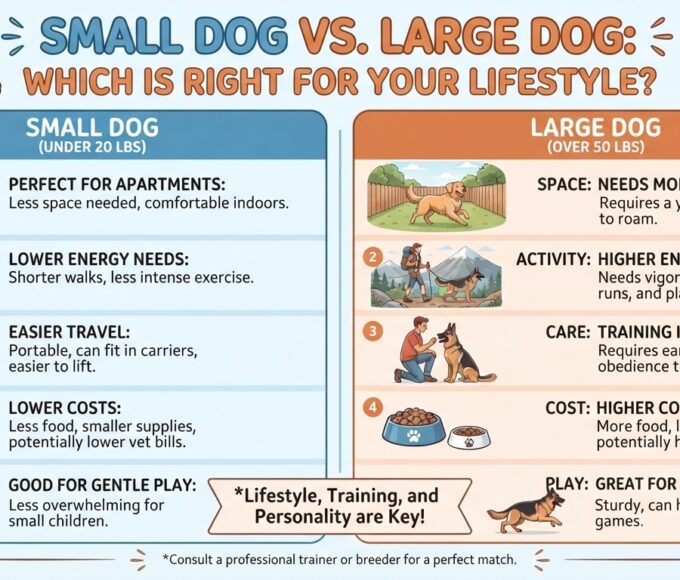
Rather than choosing a breed solely because of its appearance, consider your everyday life.
Ask yourself:
How active are you?
An athletic working breed may require much more activity than you can realistically provide.
How much grooming can you manage?
Some large breeds have thick or long coats that require considerable maintenance.
How much space do you have?
Consider both indoor space and access to safe exercise opportunities.
Can you handle the dog’s physical strength?
Training matters enormously when a dog is large enough to pull an adult off balance.
How much can you afford?
Consider food, veterinary care, grooming, equipment, and emergencies.
How much time can you provide?
Large dogs still need companionship, training, enrichment, and interaction.
Large Dog Breeds Worth Researching
There are many different large breeds, each with its own characteristics.
Examples include:
- Great Dane
- Newfoundland
- Saint Bernard
- Bernese Mountain Dog
- Labrador Retriever
- Golden Retriever
- German Shepherd
- Rottweiler
- Great Pyrenees
- Irish Wolfhound
- Leonberger
- Standard Poodle
- Doberman Pinscher
- Greyhound
This list isn’t a ranking. Each breed has different exercise, grooming, training, temperament, and health considerations.
Mixed-breed dogs can also make wonderful large companions, and shelters frequently have adult dogs whose personalities are already more established.
Frequently Asked Questions
Are large dogs good family pets?
Many large dogs can be excellent family companions, but breed and individual temperament matter. Families should consider the dog’s energy level, training, behavior, and compatibility with children and other pets.
Do large dogs need a large house?
Not necessarily. Some large dogs are relatively calm indoors. However, every dog needs enough space to move comfortably along with regular opportunities for exercise and enrichment.
Are large dogs difficult to train?
Not inherently. Many large breeds are intelligent and responsive to training. However, their physical strength makes early training particularly important.
Do large dogs need more exercise than small dogs?
Not always. Exercise requirements depend on breed, age, health, and individual energy level. Some smaller breeds can be extremely active, while some giant breeds are comparatively relaxed.
Are large dogs safe around children?
Individual temperament and training matter more than size alone. Even a gentle large dog can accidentally knock over a young child, so children and dogs should be supervised and taught appropriate interactions.
Are giant breeds expensive to own?
They can be. Food, equipment, grooming, transportation, and some veterinary expenses may be higher than they are for smaller dogs. Prospective owners should budget for both routine and unexpected costs.
Can large dogs live in apartments?
Some can, depending on their temperament and exercise needs. Apartment suitability isn’t determined by size alone. A calm large dog may adapt better than a highly energetic smaller dog, provided its daily needs are met.
Final Thoughts
Large dogs have a special appeal. Their impressive size can be matched by equally impressive personalities, from affectionate family companions to energetic working partners.
But the best large-dog experience comes from understanding what you’re actually taking on.
A big dog needs more than a large bed and a big food bowl. They need appropriate nutrition, regular veterinary care, training, socialization, exercise, mental stimulation, safe equipment, and a household prepared to accommodate their physical size.
When those needs are met, a large dog can become an incredibly rewarding member of the family.
Whether you choose a giant purebred, a large mixed-breed rescue, or an adult shelter dog, focus on the individual animal and how their needs fit your lifestyle. The biggest dog in the room isn’t necessarily the most difficult—or the easiest. What matters is finding a companion whose personality, energy level, and needs are compatible with the life you can provide.






Leave a comment