




When choosing a dog, size is one of the first things many people consider.
A small dog may seem easier to manage, while a large dog may appear better suited to an active lifestyle. But the reality is more complicated.
Both small and large dogs can make wonderful companions. The important question is which dog’s needs fit your lifestyle.
This guide compares small vs large dogs across exercise, living space, food, training, grooming, handling, and everyday care.
Exercise Needs
One common misconception is that small dogs don’t need much exercise.
Some small breeds are extremely energetic and may need considerable physical and mental stimulation.
Likewise, some large dogs have relatively moderate exercise requirements.
Instead of judging exercise needs only by size, research the individual breed and dog.
Consider how much time you can realistically spend walking, playing, and training every day.
Space at Home
Large dogs naturally require more physical space.
A large dog may need enough room to move comfortably around your home, and their size can make small apartments feel more crowded.
However, living space isn’t the only consideration.
A small dog with high energy may become frustrated without enough activity, even in a large home.
A large dog with moderate energy may be comfortable in a smaller home if they receive appropriate exercise and enrichment.
Food Costs
Large dogs generally consume more food than small dogs.
Over the course of a year, this can make feeding costs significantly different.
You should also consider treats, supplements if recommended by a veterinarian, and the cost of appropriate food as your dog grows.
When budgeting for a dog, food is only one part of the overall cost.
Veterinary Costs
Veterinary costs can also vary with dog size.
Medication dosages, anesthesia requirements, food, parasite prevention, and other expenses may sometimes be influenced by body weight.
Large dogs may also be predisposed to certain orthopedic conditions, depending on breed.
Small breeds have their own potential health concerns.
The best approach is to research the health considerations associated with the individual breed rather than assuming that one size is always healthier.
Training
Both small and large dogs need training.
However, the consequences of certain behaviors can be different.
A large dog jumping on someone can potentially knock a person over.
A small dog jumping up may be physically less intimidating, but allowing unwanted behavior simply because the dog is small can create other problems.
Basic training should be taken seriously regardless of size.
Teach your dog useful behaviors such as coming when called, walking politely, and responding to basic cues.
Handling and Transportation
Small dogs are generally easier to pick up and transport when necessary.
They may also fit more easily into appropriately sized carriers.
Large dogs can require larger vehicles, stronger equipment, and more planning for transportation.
If you travel frequently, consider how the dog’s eventual adult size will affect your transportation options.
Grooming
Size doesn’t automatically determine grooming needs.
A small long-haired dog may require more grooming than a large short-haired dog.
Look at:
- Coat length
- Coat texture
- Shedding
- Matting tendency
- Professional grooming requirements
Consider both the time and financial cost of maintaining the dog’s coat.
Travel and Holidays
Small dogs can sometimes be easier to accommodate during travel because of their size.
However, travel policies vary between airlines, hotels, transportation companies, and other businesses.
Large dogs may require more planning.
If you regularly travel, research realistic transportation and accommodation options before choosing a dog.
Children and Dogs
Parents should consider the dog’s temperament and the child’s age rather than focusing only on size.
A small dog can still be frightened or injured by rough handling.
A large dog can accidentally knock over a young child.
Children should always be taught how to interact appropriately with animals, and young children should be supervised around dogs.
Small Dogs Can Still Need Lots of Attention
A common mistake is assuming a small dog can simply be carried around all day.
Dogs need opportunities to walk, sniff, explore, train, and interact.
Some small breeds can be particularly energetic.
Treat the dog according to its individual needs rather than its physical size.
Large Dogs Need Appropriate Equipment
Large dogs may need stronger and appropriately sized collars, harnesses, beds, crates, and toys.
Everything should fit correctly.
A bed designed for a small dog won’t provide enough room for a large breed to stretch comfortably.
Similarly, toys should be appropriate for the dog’s size and chewing habits.
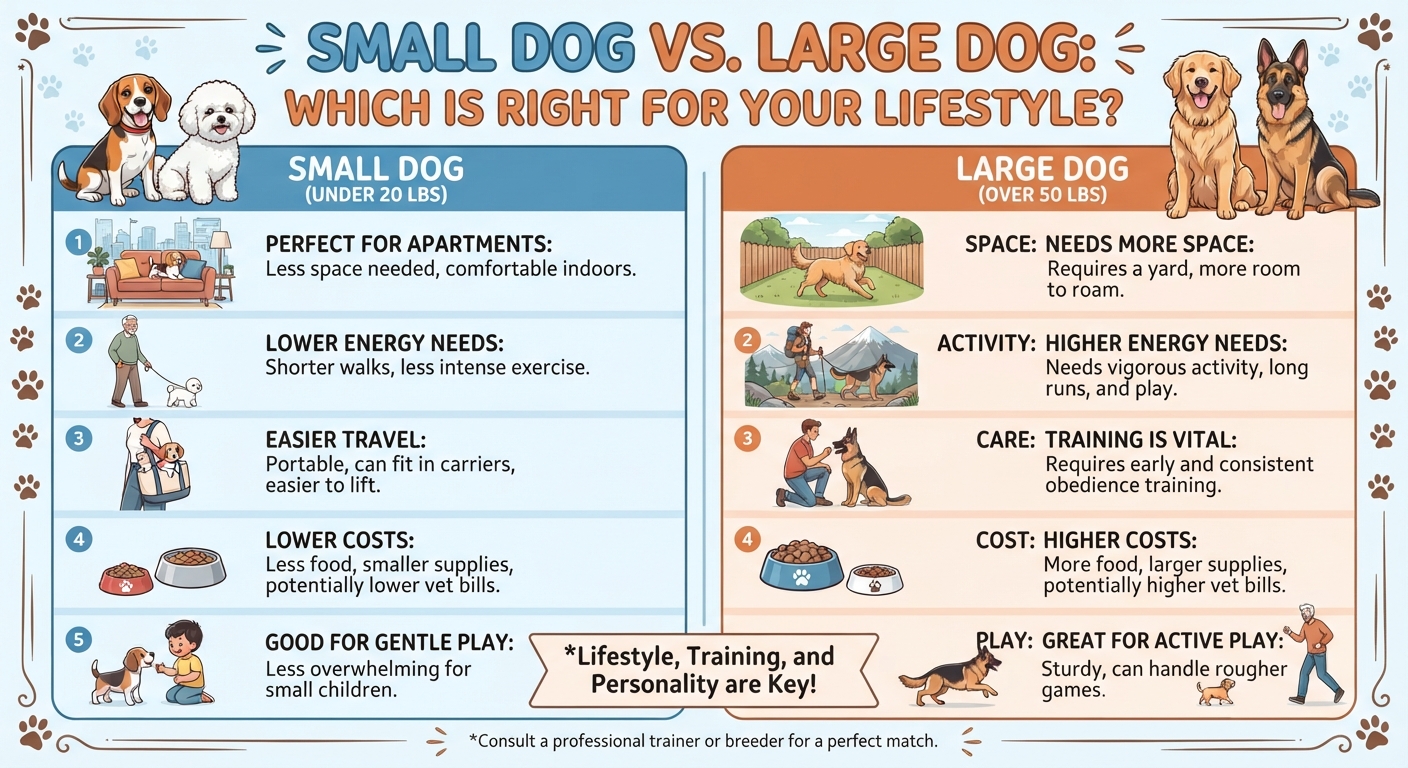
Small Dog vs. Large Dog: A Quick Comparison
| Factor | Small Dogs | Large Dogs |
|---|---|---|
| Food requirements | Usually lower | Usually higher |
| Physical space | Usually easier to accommodate | Generally needs more space |
| Transportation | Often easier | May require more planning |
| Exercise | Varies by breed | Varies by breed |
| Grooming | Depends on coat | Depends on coat |
| Training | Still essential | Especially important |
| Equipment | Smaller equipment | Larger equipment |
| Handling | Generally easier physically | Can require more physical management |
Which Size Is Right for You?
Ask yourself a few practical questions:
How active are you?
If you enjoy long outdoor activities, consider breeds whose exercise needs match that lifestyle.
How much space do you have?
Consider the dog’s adult size rather than its puppy size.
Do you travel often?
Think about transportation and accommodation.
Can you handle a large dog physically?
This matters particularly for walking and emergency situations.
What grooming routine can you manage?
Coat care can be more important than size.
Final Thoughts
The small vs large dogs decision isn’t simply about choosing between a convenient dog and a demanding dog.
Both sizes come with advantages and responsibilities.
Instead of asking which size is universally better, think about which dog’s needs you can realistically meet.
Research the individual breed, consider the adult dog’s expected size, and be honest about your available time, space, budget, and lifestyle.
The best match is one where your daily routine and the dog’s needs fit together naturally.
Frequently Asked Questions
Are small dogs easier to care for?
They can be easier to physically handle and transport, but they still need exercise, training, grooming, and veterinary care.
Do large dogs need more exercise?
Not necessarily. Exercise requirements depend heavily on breed, age, health, and individual temperament.
Are small dogs better for apartments?
Some small dogs adapt well to apartments, but energy level and barking tendencies should also be considered.
Are large dogs more expensive?
They can have higher food and equipment costs, and some veterinary expenses may also be influenced by body size.







Leave a comment